Please help with DC wiring

Feb 6, 1998
11,759
Canadian Sailcraft 36T Casco Bay, ME
How's this? I included the wire size (Might still change all 1/0 wire to 2/0, price is negligible and I'm starting from scratch anyway). I haven't worked on fuse sizes yet. I know the fuse is supposed to protect the wire, so because my starter motor will never be pulling the amount of amperage that the 1/0 cable is able to deliver I should be ok with 150A~200A?
If you are going with 1/0 or 2/0 then you will want 250A or larger. I am confused as to why you have two 1/2/BOTH switches...? Two of these can become confusing to those who don't know your boat and may need to do something per your request....
 
May 13, 2011
86
Catalina 30 Vancouver, BC
If you are going with 1/0 or 2/0 then you will want 250A or larger. I am confused as to why you have two 1/2/BOTH switches...? Two of these can become confusing to those who don't know your boat and may need to do something per your request....
Could you elaborate as to why a 250A? I read a bunch of posts by you on fuses and loads. In one of them you posted that the M25 starter has a max inrush amp draw of 225A (or something like that), in an earlier post on here someone had mentioned that they thought saw a post by you saying the continous draw of the M25 starter was about 150A. So knowing all that wouldn't a 200A fully support my most hungry DC load? I also read about voltage drops over fuses so maybe that is why you are suggesting 250A+ ?
 
Feb 6, 1998
11,759
Canadian Sailcraft 36T Casco Bay, ME
Could you elaborate as to why a 250A? I read a bunch of posts by you on fuses and loads. In one of them you posted that the M25 starter has a max inrush amp draw of 225A (or something like that), in an earlier post on here someone had mentioned that they thought saw a post by you saying the continous draw of the M25 starter was about 150A. So knowing all that wouldn't a 200A fully support my most hungry DC load? I also read about voltage drops over fuses so maybe that is why you are suggesting 250A+ ?
The last thing you want is a nuisance trip. Running fuses at close to their load can create edge burn and they can eventually nuisance trip.. The fuse is protecting the wire, nothing else. If you have large wire, use a large fuse and you will eliminate nuisance trips and also minimize voltage drop across the fuse..

If either bank can start the motor then you want both banks with the same size fuse. Would a 200A do it. Sure but a 250A+ would never have an issue where a 200A is on the border. The fuses cost the same....

Under ABYC standards a 1/0 wire can handle a fuse as large as 425A (using the 150% rule). 2/0 can handle a fuse as large as 475A (using the 150% rule).. At 100% 1/0 is 285A and 2/0 is 330A....

Any time motor starting is involved you want to use the largest fuse you can for the wire. This is one reason why the ABYC allows for the 150% rule for OCP/Max Ampacity..

If you short your battery cables those orbital batteries will vaporize even a 500A fuse in milliseconds...
 
May 13, 2011
86
Catalina 30 Vancouver, BC
The last thing you want is a nuisance trip. Running fuses at close to their load can create edge burn and they can eventually nuisance trip.. The fuse is protecting the wire, nothing else. If you have large wire, use a large fuse and you will eliminate nuisance trips and also minimize voltage drop across the fuse..

If either bank can start the motor then you want both banks with the same size fuse. Would a 200A do it. Sure but a 250A+ would never have an issue where a 200A is on the border. The fuses cost the same....

Under ABYC standards a 1/0 wire can handle a fuse as large as 425A (using the 150% rule). 2/0 can handle a fuse as large as 475A (using the 150% rule).. At 100% 1/0 is 285A and 2/0 is 330A....
Thank you :) and I apologize if some of my questions are a bit "dumb" or redundant. It all helps me understand.
 
Feb 6, 1998
11,759
Canadian Sailcraft 36T Casco Bay, ME
Thank you :) and I apologize if some of my questions are a bit "dumb" or redundant. It all helps me understand.
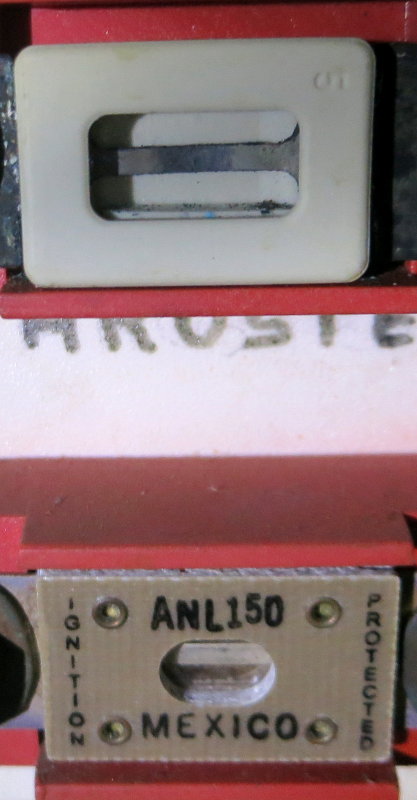
The top ANL fuse in this photo has been run at more current than it should be. It is suffering edge burn and beginning to distort & discolor from over heating. It is for a bow thruster and is the "manufacturers" recommended fuse size. The manufacturer simply recommended a fuse too small for the thruster (would not be the first time).

It had blown 4 times and been replaced four times with the same size fuse..:doh: This one was only a few blasts away from another nuisance trip. We upped the fuse to match the wire it was protecting and it now looks like the bottom fuse.

The bottom fuse is for an alternator that runs at 80A...


May 10, 2008
392
Catalina 355 Boston
Ver 1.0.3 :)
POS BUSS is going to be a must as those lugs are quite large. The only other suggestion would be to use a #4 for your charger as well, in addition to lower resistance, you can keep it consistent with the rest of your setup.
Given the length of runs on your boat (I used to own a C30 and have helped rewire a couple of others), 2/0 will certainly be more than adequate--the real advantage is the 2/0 is a little less difficult to run.

p.s.--I will get you those measurements for all of the wire sizes you are considering in the next couple of days...
 
May 13, 2011
86
Catalina 30 Vancouver, BC
The top ANL fuse in this photo has been run at more current than it should be. It is suffering edge burn and beginning to distort & discolor from over heating. It is for a bow thruster and is the "manufacturers" recommended fuse size. The manufacturer simply recommended a fuse too small for the thruster (would not be the first time).

It had blown 4 times and been replaced four times with the same size fuse..:doh: This one was only a few blasts away from another nuisance trip. We upped the fuse to match the wire it was protecting and it now looks like the bottom fuse.

The bottom fuse is for an alternator that runs at 80A...


I'm assuming that alternator wire gets fused close to the alternator and not close to the batteries?
 
Feb 6, 1998
11,759
Canadian Sailcraft 36T Casco Bay, ME
I'm assuming that alternator wire gets fused close to the alternator and not close to the batteries?
No, within 7" or as close as possible to the battery bank end. Self limiting devices such as alternator or solar do not require OCP at the device end...
 
May 13, 2011
86
Catalina 30 Vancouver, BC
In case the PDF file is hard to see the diagram shows a 300A fuse between batteries and their respective +buses, the charger output 80A and the alternator 150A. It's all reflected in ver. 1.0.4
 

Attachments

Feb 6, 1998
11,759
Canadian Sailcraft 36T Casco Bay, ME
In case the PDF file is hard to see the diagram shows a 300A fuse between batteries and their respective +buses, the charger output 80A and the alternator 150A. It's all reflected in ver. 1.0.4
Why the two 1/2/both switches..?
 
May 13, 2011
86
Catalina 30 Vancouver, BC
Because I have them, you suggested a regular on/off switch between starter and battery bank which I'd have buy. All I have to do is place both switches in position 1 for most of the time.
 
Feb 6, 1998
11,759
Canadian Sailcraft 36T Casco Bay, ME
Because I have them, you suggested a regular on/off switch between starter and battery bank which I'd have buy. All I have to do is place both switches in position 1 for most of the time.
Just make sure you write up an instruction sheet for your switches, laminate it, and keep it on-board..
 
May 13, 2011
86
Catalina 30 Vancouver, BC
Just made another change, was reviewing it and didn't catch it till now. I had a connection between common of one switch to 2 bank on the other, kind of a pointless connection... Is there a way to either modify or wire a 1,B,2,Off witch so it only works as 1,2,Off?
 

Attachments

May 13, 2011
86
Catalina 30 Vancouver, BC
Could I get a review from you guys on the latest version, I'm getting pretty close to starting the physical install. I added the AC side of the wiring in the latest version. Thank you!

P.S. If some of you would like a TurboCAD drawn diagram of your boats wiring I'm willing to do it for free time allowing :)
 

Attachments

Sep 28, 2008
922
Canadian Sailcraft CS27 Victoria B.C.
I would add a galvanic isolator to the incoming shorepower line for corrosion control.
 
Feb 26, 2004
23,352
Catalina 34 224 Maple Bay, BC, Canada
Re the second 1-2-B switch.

What is the purpose of the short wire from the bus between the switch and the ACR doing for you? The ACR feeds into the reserve bank.

If you eliminate this wire, the second 1-2-B simply becomes the I/O switch we've been suggesting, per the wiring diagrams previously linked, and as suggested by Maine Sail. We recognize you already own the switch, but using it simply is a lot easier, although it will still require an on board wiring diagram and instructions.