What size Dock Lines do I Need..?

Squidd

.
Sep 26, 2011
890
AMF Alcort Paceship PY26 Washburn Wi. Apostle Islands
I don't have a perment slip, so the lines go with the boat...

27' 6800# shoal keel....working lengths I pretty well set with, but diameter and braid has me spooked...

I have 7" cleats on the boat and have been using a mix of 1/2" double braid, 1/2" three strand, and 5/8" 3 strand (stern,bow and midship respectivly) and while they are well weathered, they have for the most part held me secure.

However on one particularly breezy day tied off on the downwind side of a pier in an unprotected part of the bay, the waves really pounded pulled and yanked my boat to the point the lines started breaking...

I usualy tie on with three lines when one broke and then the three strand poped into a two strand...fortunatly I was on deck when it happened and was able to double up all three lines (6 total) until we were able to cut lose and pull away from the pier compleatly...

So I'm in the marke to replace/upgrade my lines...I'm thinking 5/8" all around, maybe 3/4" if that's not overkill and question if I should get 3 strand for strech or double braid for strength..?

What say ye...
 
Sep 15, 2009
6,244
S2 9.2a Fairhope Al
I don't have a perment slip, so the lines go with the boat...

27' 6800# shoal keel....working lengths I pretty well set with, but diameter and braid has me spooked...

I have 7" cleats on the boat and have been using a mix of 1/2" double braid, 1/2" three strand, and 5/8" 3 strand (stern,bow and midship respectivly) and while they are well weathered, they have for the most part held me secure.

However on one particularly breezy day tied off on the downwind side of a pier in an unprotected part of the bay, the waves really pounded pulled and yanked my boat to the point the lines started breaking...

I usualy tie on with three lines when one broke and then the three strand poped into a two strand...fortunatly I was on deck when it happened and was able to double up all three lines (6 total) until we were able to cut lose and pull away from the pier compleatly...

So I'm in the marke to replace/upgrade my lines...I'm thinking 5/8" all around, maybe 3/4" if that's not overkill and question if I should get 3 strand for strech or double braid for strength..?

What say ye...
White 3-Strand Nylon, 1/2'' Diameter, 7500lb. Breaking Strength, Max. Length 600' White 3-Strand Nylon, 1/2'' Diameter, 7500lb. Breaking Strength, Max. Length 4800' White 3-Strand Nylon, 9/16'' Diameter, 9400lb. Breaking Strength, Max. Length 600' White 3-Strand Nylon, 9/16'' Diameter, 9400lb. Breaking Strength, Max Length 2400' White 3-Strand Nylon, 5/8'' Diameter, 12,200lb. Breaking Strength, Max. Length 600' White 3-Strand Nylon, 5/8'' Diameter, 12,200lb. Breaking Strength, Max. Length 2400' White 3-Strand Nylon, 3/4'' Diameter, 16,700lb. Breaking Strength, Max. Length 600'

looking at the chart for breaking stringth i would say that 9/16 would be a good choice for your size boat especially sence you use three lines per side....anything more would be too much to use on the 7" cleats.......

also bare in mind that you do have to replace theses from tome to time as the saying goes nothing last for ever ...


regards

woody
 
Last edited:

TLW

.
Jan 15, 2013
271
Oday 31 Whitehall, MI
I'm with Gettinthere on this one. RE your question on double braid vs twist - keep in mind that double braid DOCKLINES are also made of NYLON to provide some stretch.

It is only DB "yacht line" for halyards, control lines, that is made of Dacron or aramid fibers to create a line of little to no stretch.

The DB dock lines will have a softer "hand", be more supple to work with, and last longer. However, they are considerably more expensive than twist. They will be sale priced from time to time during the year, and at boat shows.
 
Mar 1, 2012
2,182
1961 Rhodes Meridian 25 Texas coast
In the first place, 7 inch cleats on your boat kinda suck. I had them on my 25 footer- now have TWO twelve inch Bronze Herrshoff style on the bow and 8 inchers on the stern quarters. Most production boats come to you equipped with woefully undersized cleats.. If you can't cleat down EASILY, TWO, and preferably 3 of the lines you normally use, the cleat is TOO DAMNED SMALL.

I tie my 7000 pound (loaded) 25 footer with 1/2 3 strand. I used to use 5/8 ths on my 35 foot trimaran. On your boat I'd guess 5/16 wold be completely adequate. But then I'm in a well protected Marina. Open to weather, go up a size. Of utmost importance too is chaff protection- I have canvas around the lines on deck, AND on the dock, so the lines never touch the cleats or chocks.

Another idea, which I haven't tried, - the boat on the dock next to me has coiled springs tied into his lines, so if the boat surges, the spring takes the initial surge , before the lines feel the strain. Sorta like the rubber surge protectors you see, but cheaper.

Personally, I think the rubber would be better

Oh and as an aside- when cruising away from home port. I want several llines that are shorter, and at LEAST two that are longer than the boat, for use as spring lines in tidal areas.. I really prefer more than that:) I normally move around with at least 6 dock lines aboard

Another idea is to set out a beam anchor (using the dink) away from the dock, with a bridle led bow and stern. I laid for a month in Florida, while away from the boat, with this set up- worked welll
 
Jan 22, 2008
296
Islander Freeport, 41 Ketch Longmont, CO
Here is my setup:

Hunter 28 - 7800#
South facing slip on an inland lake 3 mile fetch direct to the dock.

I use 2 bow lines, 2 spring lines (only need to spring into the slip - no wind or wave to blow us out), 2 stern lines.

I'm on my 3rd season with 5/8 double braid (picked for color not strength), we regularly get winds of 40-50 mph and have on occasion clocked winds at 80+. During a storm, I am not protected and regularly have 4 ft waves on the dock, which has and does cause damage to boats as well as make it dangerous to walk on the slip fingers.

2 things keep the boat secured.

1. Snubbers on all 6 lines. properly installed I've watched a 5/8 snubber stretch to more than double its length during a storm. The only dock lines we ever break on our docks are on those boats that have not installed snubbers on the dock lines.
2. Balance the lines such that when the boat surges forward (or back) the lines come tight at the same time. By balancing the lines so that no one line ever has to take the entire load and utilizing snubbers to help with the load your lines will last a long time

During a storm when the wind is blowing from the south, I've seen all 4 lines come tight at the bow and each snubber stretched almost double. My lines will go back on next year since they show almost no wear, even after 2 long seasons.
 

DougM

.
Jul 24, 2005
2,242
Beneteau 323 Manistee, MI
I have always used 5/8 lines with snubbers on my 33 foot boat even though 1/2" is probably adequate. I have chafe guards on the lines where they go through the fairleads. If the cleats on the boat were bigger, I would consider 3/4 line. Right now, the 5/8 line has "grown" in diameter to the point where it looks like 3/4". I added midship cleats for spring lines, since my boat never had them. The major problem I have encountered is abrasion that occurs when the marina gets rocking and rolling in certain windy conditions. I have seen dock lines completely cut through in a day's time.

No matter what diameter, they don't last forever. Sun damage doesn't help either. Buy a 600 foot spool, and make up lines as needed. Splicing the loops is easy, and it's less expensive than buying ready made lines which seem to come in two basic length ranges as specified by Mr. Murphy (too long and too short).
 
May 16, 2007
1,509
Boatless ! 26 Ottawa, Ontario
My understanding is that the boat manufacturer sizes the cleats for a certain sized line so the line will break before the cleat pulls out and holes the boat. If you decide to install bigger cleats reinforce the area under the cleat as well.

I like nylon lines, no bigger than required with lots of stretch, obviously chafe protection is more important with smaller lines. Lots of stretch makes it hard to break the line and less shock loading of everything on the boat. If the boat stops hard with every wave it strains everything else in the boat.

I have a 36 ft boat, dry weight is 14K but with generator and all our live aboard stuff I am guessing we are around 17K at least. Right now In our somewhat protected marina I'm using 1/2" lines, I also have 5/8" I use on occasion. I have enough 1/2" dock lines I could always double some up if a big storm was coming.

I buy the dock line by the spool and just tie a loop in one end. I don't bother with a splice because the loop sometimes needs to be bigger or smaller depending on what we are tying up to.

Bob
 
May 13, 2013
29
Tayana 48DS Phoenix, AZ
I'll have to agree with a number of posters here that your existing 1/2" lines are big enough, and that your failures are related either to sun exposure or, more likely, chafe. I use a mix of 3/4" and 5/8" on our 48' 34,000# Tayana in Emeryville (SF Bay) and we get a LOT of wind at times in the winter. I built all my current lines in 2006 when we moved up from San Diego, and if I were staying, I would replace 'em all in the next year or two based on weathering, even though I've had no failures. The cost of a couple hundred feet of 3-strand is small compared to the cost of the boat getting loose when I'm not there to fix it!

Chafe protection is mandatory - anywhere the line passes a hard point - even highly polished ones like your SS cleats and hawse-holes. I put either heavy dacron chafe sleeves, fire hose or leather covers on every cleat loop (my lines are made up to fit my slip, so no need to adjust on the cleat) and on the line where it passes thru the hawse holes. Vinyl tubing/hose works too, but needs more frequent replacement due to sun damage.
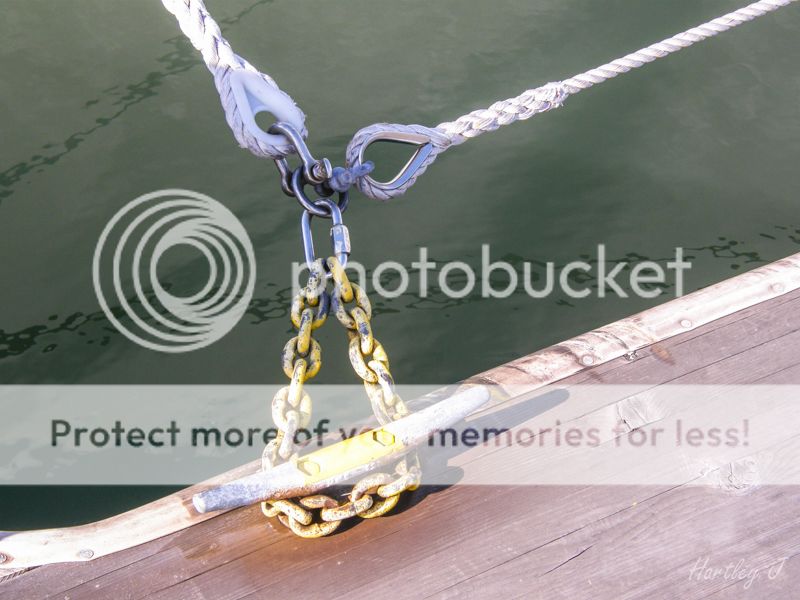
Rougher things like galvanized cleats will chew through a thick line in one season if you don't do something about it. In my case, I made up 3/8" chain loops which are placed over the cleats and shackled to the mooring lines (this has other advantages, too - folks helping you tie up have no opportunity to shorten you up too far..:))


Yes, it's also color-coded, which reduces confusion..:) The reason for two lines is that I have both the breast and spring lines attached to this loop. I've been doing it this way since 1996, and I've never had a chain loop jump off or show significant wear which I attribute to the chain (old BBB anchor chain) being harder steel than the cleat. This particular chain loop works back & forth pretty much constantly, and while the cleat is a bit shiny/worn, the chain seems unaffected.
No matter what you do, you have to inspect frequently - if you see broken fibers or the nylon "crackles" when you bend it, action is required!

Hartley
 
Jan 19, 2010
12,754
Hobie 16 & Rhodes 22 Skeeter Charleston
....Another idea, which I haven't tried, - the boat on the dock next to me has coiled springs tied into his lines, so if the boat surges, the spring takes the initial surge , before the lines feel the strain. Sorta like the rubber surge protectors you see, but cheaper.

Personally, I think the rubber would be better.....
I use an old bumper for this purpose. I run the line through the grommet on one end of the bumper, then around the bumper twice, then through the grommet on the other side of the bumper. When the boat surges, the line squeezes the bumper some and the bumper absorbed some of the shock. I guess I'm just too cheap to buy one of those rubber snubbers and I had an old nasty bumper in my shed .... seems to work. 2 cents worth of advice and worth even less perhaps????
 
May 6, 2012
303
Hunter 28.5 Jordan, ON
I use an old bumper for this purpose. I run the line through the grommet on one end of the bumper, then around the bumper twice, then through the grommet on the other side of the bumper. When the boat surges, the line squeezes the bumper some and the bumper absorbed some of the shock. I guess I'm just too cheap to buy one of those rubber snubbers and I had an old nasty bumper in my shed .... seems to work. 2 cents worth of advice and worth even less perhaps????
I like this idea.
 
Feb 26, 2004
23,129
Catalina 34 224 Maple Bay, BC, Canada
I use an old bumper ...and I had an old nasty bumper in my shed .... seems to work. 2 cents worth of advice and worth even less perhaps????
Cleaning old fenders: paint brush and roller cleaner. Works much better, faster & easier than acetone or ANY commercial/marine fender cleaners. ACE Hardware is your friend. You dock neighbors will appreciate a cleaner one. :)