Shipshape
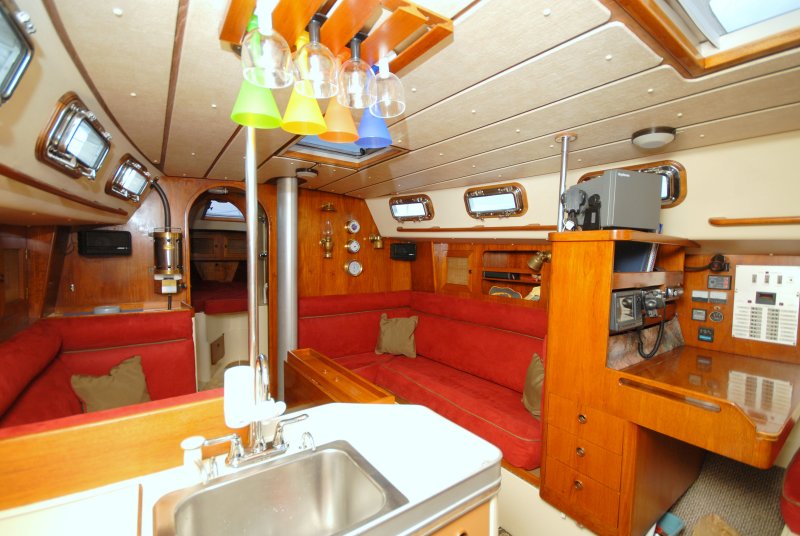
The Treaty of Alliance is a three-masted schooner that replcates some of the ships used during the 1781 Battle of Yorktown.
There were really two battles for Yorktown. The most famous was the nine-day siege. It was preceded by the famous battle of British and French ships off Cape Henry, nowhere near the town. Both battles depended on artillery.
A recent book, “The Guns of Independence –– The Siege of Yorktown, 1781,” by Jerome E. Greene, grew out of a playbook he wrote for Colonial National Historic Park to do interpretation during the 1981 bicentennial.
Lord Cornwallis swept into Yorktown after a hard-fought victory at Guilford Court House in North Carolina. He had to capture and control Virginia to win the war.
The Marquis de Lafayette’s Continental troops were crucial to the effort. General Washington and Lafayette arrived in Williamsburg on Sept. 14 to plan their siege. Washington’s success is largely credited to his own swift reaction by mobilizing the troops to leave New York and march 500 miles south to a staging area called Williamsburg.
It took days for the Americans and French to dig and fortify a long trench ten feet wide and four feet deep from which to attack by cannonball. Greene writes, “Cornwallis was utterly unaware that 1,500 men were digging a siege parallel a mere 600 yards from his main line of defense.”
The British defense perimeter surrounded the town, with two outliers. Fusiliers’ Redoubt overlooking the York was a veritable fort that withstood all the blows inflicted and never surrendered until the capitulation. Redoubts 9 and 10 south of town and near the river were overtaken by Lafayette’s troops and a young American lieutenant colonel by the name of Alexander Hamilton.
Washington ceremoniously lighted the fuse for the first artillery round, killing the British commissary-general and injuring a lieutenant. He nearly took one himself Oct 3 when a British shot landed nearby.
The town itself became a wreck. While the notion of Thomas Nelson firing on his own house is quaint, the reality was that thousands of cannonballs were showered on the village, splintering everything and killing civilians as well as troops. Smallpox was rampant. Dead horses were dragged into the river, only to float back on the tide. Desertions occurred on both sides of the line.
Greene calculated that 15,437 artillery balls were shot by the allies. “an average of more than 1,700 rounds per day, or 71 rounds per hour.”
The York River played a crucial role, essentially trapping Cornwallis.
The Comte de Grasse had penetrated the Chesapeake Bay in late August and proceeded to Jamestown to offload French troops to support Lafayette. Just before the battle of the Capes, he deployed four ships to blockade the York River from any rescue by Sir Henry Clinton, Cornwallis’ superior in New York. Clinton’s 23 ships with 5,000 soldiers were sent too late anyway.
The battle of the Capes took only two hours on Sept. 5, but it effectively broke the British blockade of the Chesapeake Bay.
Even before the siege, Cornwallis thought of sending 2,500 men up the York and into Queens Creek to surprise the allies at Capitol Landing. As things got worse, Cornwallis scuttled at least 29 transports and other commercial ships off the beach at Yorktown to foul the coast so de Grasse couldn’t land easily.
The battle of the Capes helped turn the tide of the war –– and the country. The British lost one ship as well as 90 men killed and 246 wounded, a comparatively small number considering the outcome in history.
Back at Yorktown, the main British ships were the Charon with 44 guns and the Guadaloupe with 28 guns. Three other warships were the Bonetta, Vulcan and Fowey.* Selected artillery rounds were stoked by fire to become “hot shots” that rained down on the ships in port and set them ablaze. “If well or luckily aimed, they could enter the powder room and obliterate all aboard.” Rochambeau successfully set ablaze the Charon by lobbing hot shots from land. “The frigate drifted slowly across to Gloucester Point, where she burned to the water’s edge and sank.”
The Guadaloupe found shelter from incoming rounds at the Yorktown cliffs, which are nearly gone today. After the surrender, the Guadaloupe was scuttled and sunk.
Things got so bad at the end that Cornwallis tried to escape in the middle of the night of Oct. 16 by sailing across to Gloucester Point. But a providential squall made his men seasick, broke up the little fleet, and forced his return.
It’s important to appreciate that the British had bottled up all the major ports along the East Coast. Once the Capes were lost, it was the French who blockaded the Bay from the Clinton relief fleet. So the tables were turned. As Greene succinctly identified Cornwallis’ fatal judgment, “...the fate of his army hinged utterly on the success of the British navy.”
On Oct. 17, a boy drummer appeared up on a parapet. “A red-coated officer joined the drummer. He lifted his hand and began waving something; it was a white handkerchief.”
Victory was sweet but hardly absolute. Washington considered the surrender “an interesting event that may be productive of much good if properly improved.”
Despite all that effort, the British returned in 1812 to block Chesapeake Bay again.
__________________________________________________________
*The Fowey was the very ship that Lord Dunmore had used to escape Yorktown in 1775 when the war began. It was finally scuttled.


 94.9 KB Views: 185
 48.5 KB Views: 160
 1,012.4 KB Views: 170