Should I connect these solar panels in series, or parallel?

Sep 30, 2013
3,683
1988 Catalina 22 North Florida
Sorry. This seems like such a simple question, and yet I have failed to find the answer.

Here's the scenario: I currently have one 30W Renogy panel on the starboard side of the boat, mounted on the stern pulpit rail. I am adding a second (identical) panel on the port side. One or the other panel will often be shaded by the mainsail.

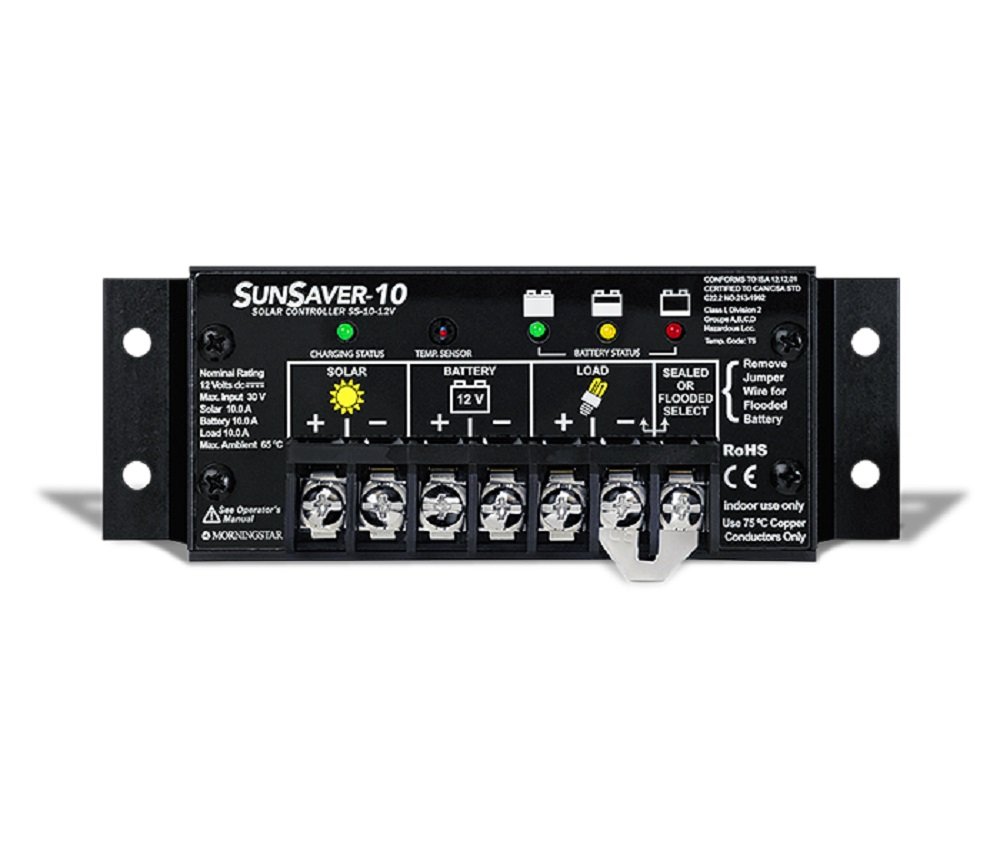
FWIW, I'm using a SunSaver-10 controller rated for 30 volts max input, and a single group 24 "Duracell Ultra" flooded battery.

So. Series, or parallel??
 
Sep 30, 2013
3,683
1988 Catalina 22 North Florida
This is an old Harbor Freight panel, but it shows the mounting method. The panel articulates up and down 90 degrees, from level as shown in this pic, to vertical (facing outward at the horizon). So in addition to one panel being shaded by the mainsail, one panel or the other will often be at a better angle to the sun, as well.

 
Jan 19, 2010
12,925
Hobie 16 & Rhodes 22 Skeeter Charleston
Most likely the panels have their own doide that will prevent back current
So connect each panel separatly to the input of you controller (parallel)
 
Sep 30, 2013
3,683
1988 Catalina 22 North Florida
There is only one set of input terminals on the controller. Just piggyback the wires onto them?
 

Sumner

.
Jan 31, 2009
5,254
Macgregor & Endeavour 26S and 37 Utah's Canyon Country
You definitely want them in parallel. In series with one in the shade it would then block the current from the other panel down to what it is putting out at that time.

You could piggy back the wires but......


..... I'd run them to a terminal strip with jumpers connecting the terminals on one side for (-) and the other for (+). Place the terminal strip by the controller then a single set of wires from it to the controller . Make sure your wires are sized for the run so you maximize the panels output....

https://www.colemanair.us/vp_asp/Scripts/Articles/TheBasicsAndBeyond5_WireSize.htm

Sumner
==================================================================
1300 miles to The Bahamas and Back in the Mac...
Endeavour 37 Mods...
MacGregor 26-S Mods...
Mac Trips to Utah, Idaho, Canada, Florida, Bahamas
 
Last edited:
Feb 17, 2006
5,274
Lancer 27PS MCB Camp Pendleton KF6BL
Yes, parallel. Series doubles the voltage but keep the current the same. Parallel doubles the current but keeps the voltage the same. So if both panels produce 17vdc at the controller, you would have 34vdc when you connect in series.

I like Sumner's little distribution panel. Good way to keep panels separate and easy to replace one if you have to.
 

walt

.
Jun 1, 2007
3,550
Macgregor 26S Hobie TI Ridgway Colorado
FYI, that controller is PWM so you really have no choice but to parallel connect the panels. If the serial connected panels didnt damage the controller by exceeding the 30 volt input spec, you would still only get the power of a single panel even without shading. No need to worry about any diodes, just connect both panels in parallel to the controller solar input. Use the bus or just one lug on top of the other then screwed down. If you are removing one or both panels often, the buss would make things easier.
 
Last edited:

walt

.
Jun 1, 2007
3,550
Macgregor 26S Hobie TI Ridgway Colorado
One little caution with that controller (since I burned a very similar one out). If you have a panel in the sunlight connected to the controller and the controller is connected to a battery, shorting the solar panel side will burn out that controller even if you have some sort of fuse in that line. I mention this as you may have one panel already hooked up and would be adding a second. A little slip that shorts the panel side with the hot system will make the controller junk. If you accidentally short the battery side you should just blow a fuse. The solar side even with a fuse is very sensitive when its running!!!

I once saw a suggestion to put a towel over the panels if your connecting them to a hot system in daylight.. not a bad idea. If you accidentally short the panel side when they are not producing any power (like at night), no problem, nothing will happen.

You probably were going to be more careful than I was... but worth mentioning. I burned mine out messing with two panels..
 
  • Like
Likes: Gene Neill
Sep 30, 2013
3,683
1988 Catalina 22 North Florida
All righty then, parallel it is, thanks everyone! Glad I asked, because I was planning to wire them in series. :redface:

I'm excited about adding the second panel. Pretty sure I'll be able to keep up with the power draw indefinitely now. With the one panel and occasional use of the motor, I've at least kept it close. But two phones, a tablet, a VHF, a bluetooth speaker, a GPS and an auto tiller have been making it a challenge!
 
Sep 30, 2013
3,683
1988 Catalina 22 North Florida
PS and thanks Walt, that's good advice. I'll throw dark towels over both panels while I'm messing about with the controller.
 
Jun 11, 2011
1,243
Hunter 41 Lewes
Morningstar equipment is pretty bullet proof. For maximum efficiency I would use two controllers and parallel the outputs. I believe that is what they suggest also but it may not be in the budget.
 
Jan 22, 2008
8,050
Beneteau 323 Annapolis MD
Gene, I spent a lot of time pondering (that means sitting in the cockpit with a glass of wine.) my installation on my two aft bimini bows with two panels. Series/parallel- which to do. SO, I ended up having it both ways with a couple of DPDT switches by the nav station. My Morningstar controller is rated for more voltage than the two panels in series.
If wired in parallel, when the voltage from the panel reaches a certain low point (say, 12.6) the batteries are no longer charged. But if you switch to series, the voltage doubles and I can squeeze every last amp before the sun goes down- or when the sun comes up. It is not too often I am that needy, though. My 2 cents.
 
Last edited:
Feb 17, 2006
5,274
Lancer 27PS MCB Camp Pendleton KF6BL
Well, that's not good. I guess all the cells in the panel are connected in series. Just like a string of Christmas lights. Remember, if one light burned out the entire string was out.