microbes in my diesel

breton

.
Jun 10, 2025
12
Catalina 28 MK II Plymouth Harbor
I am new to diesel engines (last boat was an atomic 4). This is my 2nd year with the M25XPB in a catalina 28. Last year was just a feeling out the boat year because it sat for a couple of years in the owners yard. Today I replaced both filters and was happy the quart or so of fuel from the old filters that looked clean until I recycled it and the boatyard owner said I had microbes. The empty jar had a bunch stuck to the inside after I dumped the old fuel. By a bunch I mean every inch or so in the empty jar was a little blob (about (2mm in size). The engine ran about 14 hours last season.
Last year I treated the old fuel with Power Service diesel treatment both the white and the grey. The existing fuel was a couple of years old when I bought the boat. I bought some Biobor to treat the diesel going forward.
Should I be worried? Or just run the boat with the treated fuel? Seems to run fine but I haven't tested it for a long time in rough seas.
Size wise - more like coffee grinds.

Thanks
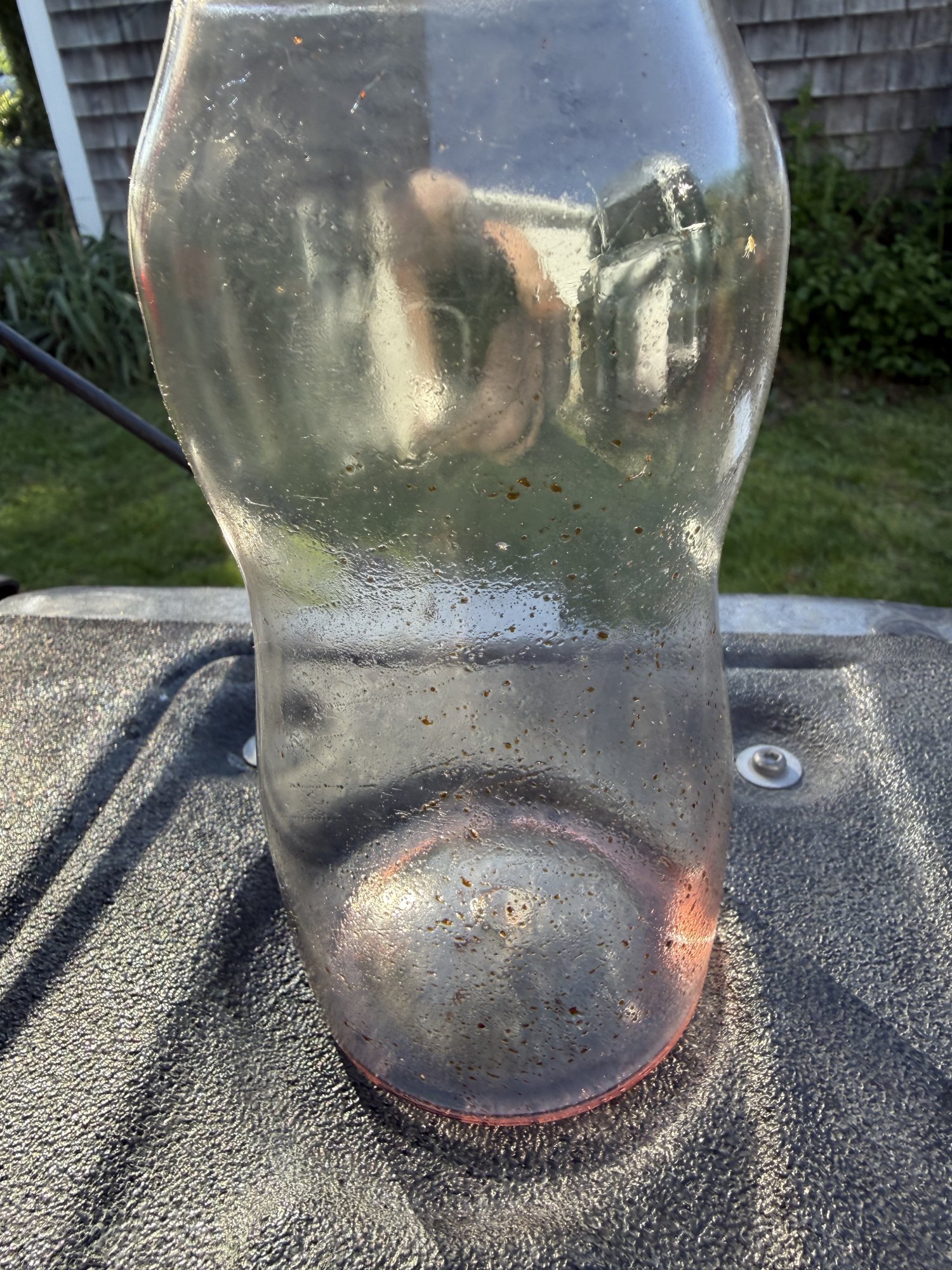
IMG_3770.JPG
 
Last edited:

colemj

.
Jul 13, 2004
1,036
Dolphin Catamaran Dolphin 460 Mystic, CT
This was the fuel poured out of the old filters? If so, then I'd expect to see some crud in it. That's the entire point of a filter. If this is the amount that was filtered over many hours of operation, then it isn't a lot.

However, any crud is still crud, and it had to come from the tank. Is there a way to visually look inside the tank? That would tell you a lot - particularly if you can get most of the fuel out before hand.

Mark
 
  • Like
Likes: breton

jssailem

SBO Weather and Forecasting Forum Jim & John
Oct 22, 2014
24,455
CAL 35 Cruiser #21 moored EVERETT WA
You have several options.
Fist I would suggest you read the Practical Sailor articles about Diesel Bugs, to familiarize yourself with the issue and develop a plan that fits your needs going forward.

  1. You can pump the fuel out and then clean the tank, clean the hoses, and install new fuel filters. (both primary - located somewhere between the tank and the engine, often labeled RACOR and secondary - that would be the one on the engine)
    1. This is a good option is your fuel tank is small and the amount of fuel in the tank is small.
  2. You can begin treating the fuel with additives designed to eliminate the diesel bugs in the tank. This means you keep the fuel. You buy fuel additives to clear out the bugs. And you maintain a supply of Primary filters, expecting to capture the dead bugs and other debris in the filter as the tank self-cleans.
When I bought my boat, I had 130 gallons of diesel in the two tanks. I was not ready to waste all that fuel (at the time in 2015, diesel was running about $5.00 per gallon). So I bought 5 filters at $10 each. I purchased the products recommended by Practical Sailor. I treated the fuel, filtered the bugs, and used my sailboat. In a short time, the bugs disappeared. The filters remained clean, and I enjoyed motor/sail cruising in the waters of the Pacific NW.

On my boat, here is what the fuel filter looked like. It is a Racor 500ma filter housing.
IMG_0786.jpeg

I use a Racor 2010PM 30 micron filter.

When they get dirty, the guage on the filter housing moves into the red, indicating the filter is getting clogged. Here is a dirty filter.
IMG_1169.jpeg

Time to change the filter. If you do not change the filter, the engine will stop. On my boat, this means a belabored process of bleeding the fuel lines after you change the filter. I got pretty good at recognizing the engine was in trouble. I learned to make a change in about 7 minutes. Stopping before the engine died meant I did not have to bleed the engine.

If you want to explore this subject here on the forums, you will find all sorts of info.
Here is a taste beginning in 2014.
 
Sep 30, 2016
429
Island Packet IP 44 Ventura, CA
Id want to take a peek inside the tank. It isnt always easy on some boats. But you can probably remove the fuel level sender, or pickup tube- anything with a flange that you can remove and take a look. Then once you do get access, its still hard to see in there. You will need a small but powerful light. But, it will tell you a lot about your problem. It should be pretty much spotless in the tank. But in the case of the OP, it wont be. Id expect to see a lot of black tar coating the walls, and/or tar bits floating around. The fist pic the OP posted seems like a lot of crud and it will clog a primary filter quickly- maybe a couple of hours. This is something that needs to be addressed, because I guarantee the engine will die at the most uncomfortable time possible. Ive had fuel bug and its a hard problem to conquer.
 
  • Like
Likes: Timm R Oday25

jssailem

SBO Weather and Forecasting Forum Jim & John
Oct 22, 2014
24,455
CAL 35 Cruiser #21 moored EVERETT WA
Ive had fuel bug and its a hard problem to conquer.
As I explained, I too combated fuel bugs. It was persistence and consistency that resolved the problem.
  • I stopped water from entering the fuel system (replace the O-rings on the fuel port cap).
  • I put additives in the fuel tank and added more each time I added fuel.
  • I changed the filters and saw that with each change, the amount of filtered contaminants was reduced.\
It is not a difficult task, but you must act on it. It will not go away by itself.

You can alternatively take the path of:
  • Empty the boat's fuel tank.
  • Physically clean the tank
  • Polish the fuel (run the fuel through filters to remove all contaminants)
  • Get new O-ring seals for any port used for fuel.
  • Only get fuel from clean sources that pump lots of fuel.
The path you choose is your own. Best of luck.
 

breton

.
Jun 10, 2025
12
Catalina 28 MK II Plymouth Harbor
This was the fuel poured out of the old filters? If so, then I'd expect to see some crud in it. That's the entire point of a filter. If this is the amount that was filtered over many hours of operation, then it isn't a lot.

However, any crud is still crud, and it had to come from the tank. Is there a way to visually look inside the tank? That would tell you a lot - particularly if you can get most of the fuel out before hand.

Mark
 
Jan 19, 2010
12,890
Hobie 16 & Rhodes 22 Skeeter Charleston
Seems to run fine but I haven't tested it for a long time in rough seas.
No first-hand experience BUT..... I have developed an adversion to diesel by reading posts on here for many many years.... and

I have read several posts where the filters are keeping up and the motor runs great but the first time in "rough seas" and it all goes to :poop:... and the reason why is the half inch of packed crud on the bottom of the tank that has been building for years gets stirred up and gums up all of the plumbing.

Just a biased thought that crossed my mind as I read your post.;)
 

KCofKC

.
Sep 6, 2010
67
Catalina 28TR MKI 317 Smithville
I think you have done the correct start. No worst than it is I would continue to run it as low as possible, treat it with Bio-Bore Jr, it will kill it all and entrap it in the filters, keep a complete set of filters on hand. Racor at least a 10 Micron, a new spin on and if you have the original fuel pump, do not forget the screen in the fuel pump if it is the round one. Get it low on fuel, fill a few more gallons in it and add more Bio-Bore Jr. Fuel issues are generally created to lack of run time ad the engine bypasses more fuel than it uses and this filters it several times and they will plug the filters in time. If you get a stall issue change the filters again. If you do not motor much or use much fuel this adds to the problem. You might also consider checking out the C-28 owners group in Yahoo, a lot of information there. If you go there check out the Wiki files there is a lot of specific instructions and photo's there. Diesels are a better choice in many ways but do need to be taken care of used often and receive proper maintenance. More marine engines are pre-maturely unusable due to not knowing what they need and how to do it. You don't say what year but it has to be about 97ish or later as there were only about 200 or so of them made a great boat overall in many ways, use it often is the best practice. It also matters if your fresh or salted, and how yo store it in the winter and storage practices. Use Sta-Bil for diesel as well. Don't panic, be consistant with it's service and it will clear up, also check the vent tub for the tank. The better you get ahead of it,, the better off you are for the future. Good luck, Ken
 
  • Like
Likes: Timm R Oday25

breton

.
Jun 10, 2025
12
Catalina 28 MK II Plymouth Harbor
Just hired USAFuelService to polish and clean the fuel. They come to you. This will make me feel more comfortable running the engine this Summer. Price $525.
 
  • Like
Likes: jssailem

dLj

.
Mar 23, 2017
5,028
Belliure 41 Back in the Chesapeake
Just hired USAFuelService to polish and clean the fuel. They come to you. This will make me feel more comfortable running the engine this Summer. Price $525.
Do they clean the tanks besides polishing the fuel for that price?

dj
 
Jun 17, 2022
519
Hunter 380 Comox BC
Just hired USAFuelService to polish and clean the fuel. They come to you. This will make me feel more comfortable running the engine this Summer. Price $525.
That's pretty reasonable. I that a final price or just for their time, filters extra?
 

breton

.
Jun 10, 2025
12
Catalina 28 MK II Plymouth Harbor
final price except $49 for a bottle of their special additive.
IMG_3787.jpeg