Inverter & Solar Panel

Status
Not open for further replies.
Aug 24, 2009
444
Catalina 310 Sturgeon Bay, WI
I posted this on the C-310 Site but did not get much of a response. It was suggested to post to all sailors - so here goes.

Has anyone added an Inverter/Charger in place of the standard charger for minor 110V electrical needs? If so, do you happen to have the wiring diagram you used to set this up? I had a unit on a past boat, but the electrical was split on the 110V side so the inverter powered outlets only, and a second part of the panel powered A/C, Hot Water, and the old charger input. I am interested in making the change as part of a battery upgrade. :D

Second Part, has anyone added Solar Panels to there boat, to bring said batteries back to charge when using an inverter? If so, looking to see how you successfully set this up, and what you did to prevent over-charging the bank from the solar set up.

Thanks in advance.... Hope someone did this on a C-310 to keep development time simple.

:dance: Russ
 
Jan 22, 2008
1,483
Hunter 37 C sloop Punta Gorda FL
I posted this on the C-310 Site but did not get much of a response. It was suggested to post to all sailors - so here goes.

Has anyone added an Inverter/Charger in place of the standard charger for minor 110V electrical needs? If so, do you happen to have the wiring diagram you used to set this up? I had a unit on a past boat, but the electrical was split on the 110V side so the inverter powered outlets only, and a second part of the panel powered A/C, Hot Water, and the old charger input. I am interested in making the change as part of a battery upgrade. :D

Second Part, has anyone added Solar Panels to there boat, to bring said batteries back to charge when using an inverter? If so, looking to see how you successfully set this up, and what you did to prevent over-charging the bank from the solar set up.

Thanks in advance.... Hope someone did this on a C-310 to keep development time simple.

:dance: Russ
Any inverter /charger you buy will come with wiring diagrams. Simply put you will have separate 110 wires in and out, and huge 12 volt wires. Search Maine Sail's web site for fantastic detail. Any solar panel capable of recharging a battery will need it's own controller to keep from cooking off the batteries. See Maine Sail's comments again.
 
Dec 19, 2006
5,832
Hunter 36 Punta Gorda
Complicated

First off I have what you want to do on my H-36 but the inverter charger was installed at the factory but the manual that came with the charger does explain all the different installations.
I can run any thing on my boat related to 110 except the AC and water heater and everything is automatic switching and explained in the inverter charger manual or you could get a marine electrical book.
I did install my own solar panels with a charge controller that keeps the batteries charged and from over charging which most need for solar panels.
I am no electrical expert but pretty handy and understand most install manuals which you get with the inverter/charger and the charge controller for the solar panels and a load of help and info right here and some expert books on Marine electric.
Nick
 
Feb 21, 2004
30
Hunter 94 P42 Marion/Sandusky, Ohio
Re: Complicated

Russ,
I do not wish to throw a wet blanket on your plans but before you begin, there is a need to understand the limitations you are facing.
The reason that your earlier boat had the inverter powering only the outlets is because you will never realistically have enough battery power to run the AC or the water heater. I have nearly 1000 amp hours of battery capacity on my boat and a 2000 watt inverter/charger which can physically power the water heater, but doing so will use around 150 amp hours (12 volt) each hour and run the batteries down in a very short time. The AC would kill the batteries just as quickly.
The second problem is that the solar panels will recharge your batteries but unless you have a huge array it will be a slow process. A 200 watt panel will only put out 120 watts on a hot day which equates to about 10 amp hours for the peak sun hours for a daily total of probably around 50 amp hours on a sunny clear day.
From that you would have to have 3 good sunny days to recover from one hour of running the water heater.
The short story is that you can run the AC and water heater when you are plugged into shore power or if you have a very powerful generator on board. Otherwise, you are going to be limited to how much battery capacity you have and how fast you can recharge the battery.
Inverters and inverter/chargers are great additions to a boat, but they really force you to manage the power usage.
 
Aug 24, 2009
444
Catalina 310 Sturgeon Bay, WI
Russ,
I do not wish to throw a wet blanket on your plans but before you begin, there is a need to understand the limitations you are facing.
NO wet blanket here Rich, good news is I never planned to run anything big. When I had my C-42, microwave or coffee pot was the most. On the C-310 it will be a TV/VCR from time to time, and a laptop (that might just be connected via adapter to 12 vdc.) Rare maybe a cup of coffee, but most of the time that is press coffee off the stove. It would be huge to try to run AC or Hot Water... but thank you for bringing that up as I was not clear in my intent. As for a panel, all my interior lighting is LED, as are my running lights. Stereo, normal instruments when sailing, and my refrigerator at 3.5 Ah when running, are the only 12 vdc draw. I was thinking a 75 watt panel could hold it's own for this draw. (only when I travel and anchor out, the boat lives at a slip)

I have been through the wiring instructions a dozen times for the unit I hope to purchase. The reason I started with the C-310 group was due to like wiring set up. What I have is the 110V power in, and a breaker panel (main disconnect) right at the back side of the plug. From there power runs to the panel in the boat and branches from another main breaker to the circuit specific breakers, one of which is the charger. My thought is to pick up the power for the charger / inverter right from that first breaker, and then pass through the inverter unit, and out to the panel (put the inverter / charger in line) this would give me my protection and have me set up. I would no longer power a charger from the breaker currently used, as they are specific in the instructions not to do so or the inverter will cycle. I would have to remember to shut off the hot water when we pull power, but that is not a big deal, as is shutting down the AC breaker, just something to get use to. When we leave the boat everything on the AC side, except the charger is shut down. In the above set up, the master 110v would be what would power down the inverter / charger.

Does this sound about right? Yes a controller on the solar panel is a must for sure with that watt unit.

Thanks for the feedback, I look forward to comments on my installation thoughts.

Russ
 
Feb 6, 1998
11,759
Canadian Sailcraft 36T Casco Bay, ME
Russ,

You may want to ditch the current charger, not a great one anyway, and get a good inverter/charger. Much easier to wire up.

Running a non auto-transfer inverter you will need to install a manual SHORE/INVERTER transfer switch... Be sure that what ever inverter you buy is a marine UL compliant one.....

Often the easiest way to install a basic inverter is to wire it directly to its own inverter-only outlets and not pass through the main panel or use the boats existing outlets...

Magnum, Mastervolt and Victron all make good quality I/C's. The X*****x brand is a crap shoot these days...

P.S. A battery charger is not powered via an inverter, only shore power or genset via shore power inlet with the transfer switch set to SHORE.. If an inverter could charge batteries via itself our energy concerns would be gone....:)
 
Feb 26, 2004
23,352
Catalina 34 224 Maple Bay, BC, Canada
Rich, you have two choices (assuming you get an I/C with its own internal ATS - automatic transfer switch, or else you'll have to do what MS suggested).

1. Inverter powers all AC loads, BUT YOU have to MANAGE the AC power to avoid turning on the hot water heater when running on inverter. This is what we have on our boat. I only run the heater when plugged in at the dock, and then only for the 15 minutes it takes to heat the water, never longer. Therefore, that switch is almost always OFF.

2. Split AC power to two circuits: one for outlets, the other for the hot water heater and air conditioning. More wiring, two switches.

Your boat, your choice.

In any event, however, the incoming AC wiring to an I/C must come to the I/C first (or the ATS) because the inverter side acts like a source of power to the AC switches. Think about it.

All combined I/C installation manuals provide a number of different options for wiring.
 
Dec 19, 2006
5,832
Hunter 36 Punta Gorda
solar panels

I think you should go bigger if going with one panel because it can't really hurt to get all that Free :dance: sun helping to charge the batteries and you don't always have sunny days and most time really don't get as much charging from the panels as you want and may find you may need battery power more than first planned and better to have bigger panel now than to add later.
We are big 12volt users on my boat and have 4-6volt T-105's and 2-190 solar panels with a charge controller to make sure no damage to batteries.
We use 12volt for charging 2-cellphones a tablet and computer and coffee maker and microwave and TV and this way my wife is very happy camper and almost like at home and even a few times a hair dryer.
While I am up in NY my panels keeping my batteries all charged up while some 12 volt fans moving air around in boat in Florida.
Nick
 
Aug 24, 2009
444
Catalina 310 Sturgeon Bay, WI
Rich, you have two choices (assuming you get an I/C with its own internal ATS - automatic transfer switch, or else you'll have to do what MS suggested).
Stu, (and Main Sail)

Again, your correct the plan is a new I/C to replace the one that is on the boat currently. I did some reading and also eliminated the X --- brand. Looking at a 1500 2 bank charging. I believe to keep it simple, I want to keep from running more 110v wire then I have to. My thought is if I pick up my incoming 110V from that main breaker / disconnect switch back at the plug, put the I/C in line right there, and feed out of the I/C from what use to be the main, I have protected and provided a way to turn off the charger part of the I/C. Keeps my 110v wire simple, and yes I have to manage what is on and off. (air is always off unless at dock anyway, as is the hot water. Like Stu, I only run it about 15-20 min a day and turn it off) By putting the I/C where I noted I then have the main breaker on the 110V panel in the boat as protection, as well as each breaker. If I remember from my last boat that had the H brand, if you did forget and over powered the I/C it went into alarm mode and shut down anyway. (not that we want to plan on that)

So much input here - so very helpful. Thanks...
 
Aug 24, 2009
444
Catalina 310 Sturgeon Bay, WI
I think you should go bigger if going with one panel because it can't really hurt to get all that Free :dance: sun helping to charge the batteries and you don't always have sunny days and most time really don't get as much charging from the panels as you want and may find you may need battery power more than first planned and better to have bigger panel now than to add later.
We are big 12volt users on my boat and have 4-6volt T-105's and 2-190 solar panels with a charge controller to make sure no damage to batteries.
We use 12volt for charging 2-cellphones a tablet and computer and coffee maker and microwave and TV and this way my wife is very happy camper and almost like at home and even a few times a hair dryer.
While I am up in NY my panels keeping my batteries all charged up while some 12 volt fans moving air around in boat in Florida.
Nick
Looking at what I have for real-estate , as I am looking at a semi flexible unit that will mount on my dodger. (keeps it all simple, and makes running wiring simple also.) I have not found one much larger than 75 that will fit up there. And yes, I forgot that once we have 110v thought the I/C she will want to run the 800 watt microwave from time to time. When I switched to LED lighting, I also put in energy efficient 2-Speed fans. (H Brand) so very little draw there. Thanks for the advice....
 
Apr 23, 2012
20
C&C 29 MKI Niagara on the Lake Sailing Club
I am in the process of upgrading my 110v system to a new Blue Seas ELI for protection and islation of stray currents. I intend to insert this ahead of the inverter/charger which outputs to the 110v board. Blue Seas mounts this on the new order of panels the smallest of which comes with space for the ELI and one other breaker. I have elected to connect the emergency battery bank charger to it, but it would be ideal to use for the hot water heater if I had one. We sail in Canada where electric tea pots are the order of the day and abound.
 
Mar 22, 2004
733
Hunter 30 Vero Beach
Russ,
Do you have a bimini that you could mount the panel on? Mounting on a dodger isn't the easiest or most efficient place to mount a solar panel. I've been considering solar, and have been doing some research. Another thing you will be up against is the sun at Hi Seas isn't the greatest. Go with the biggest panel(s) you can fit.
 
Mar 22, 2004
733
Hunter 30 Vero Beach
Not to hijack your thread, but I figured you're at Hi Seas Marina if you're in Oconto. I used to keep my boat up there before I moved to Florida. John & Cheryl have a great little marina there, and with the dredging, it can only get better. Someday I hope to get back up that way. Let us know how your solar project works out. I'm curious to see how big of panels you will need to cover your electrical needs up there.

Dave
 
Feb 6, 1998
11,759
Canadian Sailcraft 36T Casco Bay, ME
Looking at what I have for real-estate , as I am looking at a semi flexible unit that will mount on my dodger. (keeps it all simple, and makes running wiring simple also.) I have not found one much larger than 75 that will fit up there. And yes, I forgot that once we have 110v thought the I/C she will want to run the 800 watt microwave from time to time. When I switched to LED lighting, I also put in energy efficient 2-Speed fans. (H Brand) so very little draw there. Thanks for the advice....
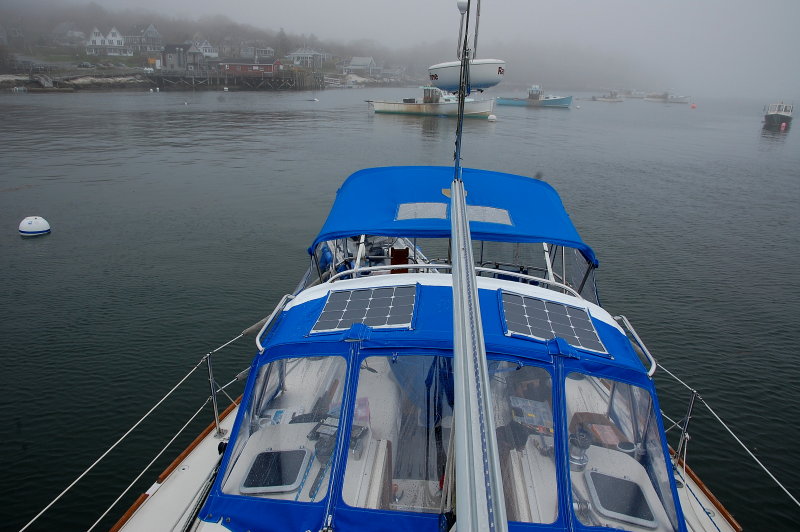
Dodger mounted panels really perform quite poorly due to shading. There is a way to sort of improve performance and that is port & starboard dodger panels each with their own controller. This allows the MPPT to track the unshaded panel for its max performance and the unshaded panel for its best performance. This 100W of pane would perform considerably better if mounted on the bimini but sometimes compromises need to be made.. Don't even think about a panel that runs the full width of the dodger or you're basically throwing money out the window... Shade is the dirty "S" word for solar....;)

This is the best option you'll find for dodger mounting.


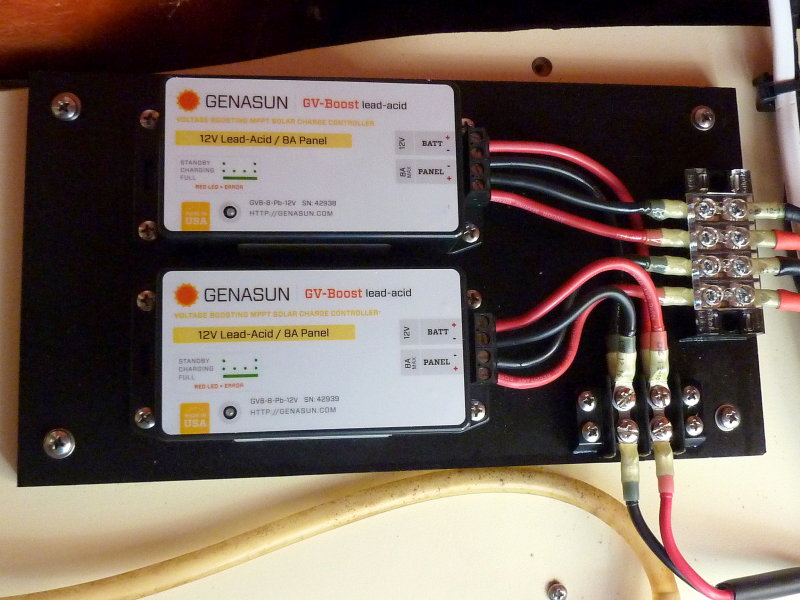
Each panel gets its own controller.
 
Aug 24, 2009
444
Catalina 310 Sturgeon Bay, WI
MS
I like the concept because you also have redundancy in the systems... thanks
 
Aug 24, 2009
444
Catalina 310 Sturgeon Bay, WI
Got some dimensions and if I move back on the Bimini I have room for some 40 watt panels, and plan / hope to split into two systems as shown above. This could do just what I need to do when I anchor out for 2-3 days and keep me powered up during a full day of sailing with everything running. Input has been great.
 
Status
Not open for further replies.