Gate valve replacement

Status
Not open for further replies.

Mitch

.
Oct 22, 2008
21
Oday 34 Lk St Clair
Hi all again. First I would like to thank all who responded to my post on my spreaders. I've talked with my salesman and he agreed that having it welded was proper. Will let ya know how it turns out. Now, I would like your opinons on replaceing a gate valve. Only one on boat. Pics are below.

The boat is a 1982 34 foot O'day. It is only freshwater sailed. The valve is on the raw water intake for the M5424 engine. The intake is the bronze type with strainer. Everyone says it should be replaced and so it will be. First, two comments. The ground wires shown in the pics will be reattached properly unlike they are now, and I have read most posts about valves here and at other places, and studied the comments at http://www.pbase.com/mainecruising/replacing_thruhulls&page=1
Now the questions:

1. If the thru-hull has NPS threads, and the valve has NPT threads, why can't someone make matching parts?

2. Should I use pipe tape or dope on the threads?

3. Notice the wood block. Mainecrusing shows how to make a backing plate using fiberglass. Can't I just lay up 5" inch or so square fiberglass cloth in place to the desired thickness? What about a thick piece of nylon expoxyed there instead of the wood? Not cheap plastic but real stroung tough nylon?

4. If I use a valve with a flange and bolt it on, that is adding three more holes below the waterline. Not something I care to do. Also, if bolted on, the thru hull would have to be cut down very exact so when screwed on and tighten, it would have enough threads mating for mechanical strength, be flush with the hull, and facing foward to scoop up water. Picking winning lotto numbers would be eaiser. :)

Thanks all. Boat floats on May 11th!

Mitch
 

Attachments

Jun 2, 2004
5,802
Hunter 37-cutter, '79 41 23' 30"N 82 33' 20"W--------Huron, OH
Age old problem, 1/2" thru-hull where nothing substantial will fit. On my '79 I temporarily used a 1/2" ball-valve. I understood the issue of tapered versus straight threads, that the straight-threaded ball valve would not screw on far enough. But I was able to get enough threads and went two seasons that way. Then I bit the bullet and replaced the thru-hull with 3/4" so that I could install a real seacock. If your boat is already out of the water then you need to do that.

Addendum: the scoop faces aft on a sailboat, not forward.
 

Attachments

Feb 6, 1998
11,760
Canadian Sailcraft 36T Casco Bay, ME
1. If the thru-hull has NPS threads, and the valve has NPT threads, why can't someone make matching parts?
They do but they are usually special order and can not be cut to length. Too much length leads to more leverage and a higher potential for failure.

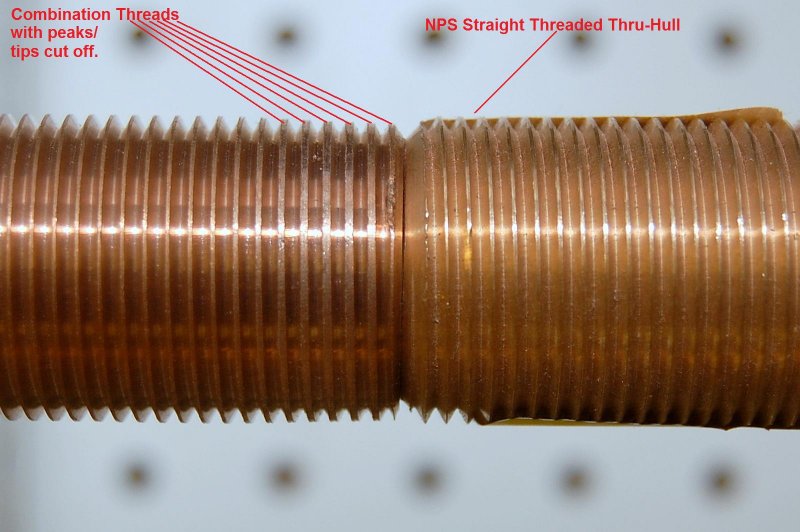
The threads on the left are on a Groco 3/4" thru-hull fitting and are machined with a combination thread end. You can tell a combination thread because the tips or peaks of the first few threads look squared off as they have taken the tips off to tried and mimic a true tapered thread. This is not a true tapered thread but will bury into an NPT fitting deeper than it would with no combination threads.

The thru-hull on the left is made by Apollo and has no combination threads. You can see by the pointed thread tips all the way to the end of the fitting that is has not been machined to be used in an NPT female fitting..


2. Should I use pipe tape or dope on the threads?

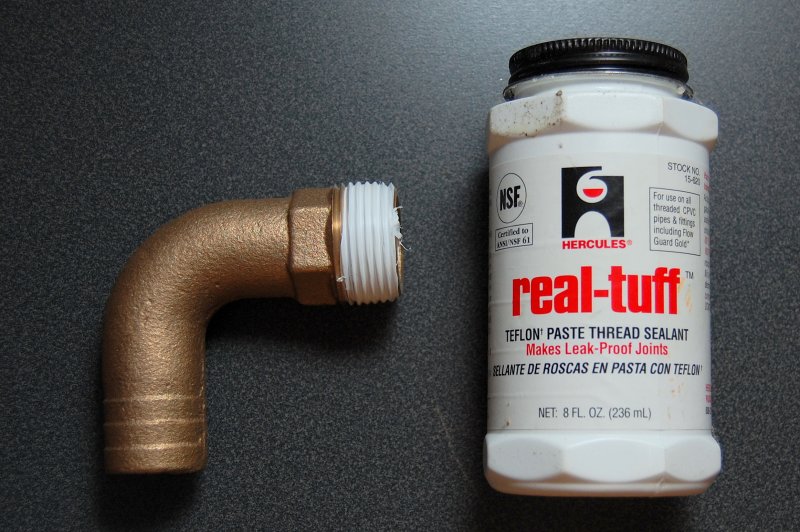
I use both as do many good pipe fitters. Thread machines get dull and out of tolerances tape and dope together is a cheap way to make sure you never have a threaded fitting leak.

Tape then dope:


3. Notice the wood block. Mainecrusing shows how to make a backing plate using fiberglass. Can't I just lay up 5" inch or so square fiberglass cloth in place to the desired thickness? What about a thick piece of nylon expoxyed there instead of the wood? Not cheap plastic but real stroung tough nylon?
I would not use any plastics there other than fiberglass. You can also buy Garolite G-10 from Mcmaster-Carr and you can avoid the whole lay up. Wood works to but do use a multi ply marine grade plywood or very stiff and dense wood like IPE but be sure to epoxy coat it.

4. If I use a valve with a flange and bolt it on, that is adding three more holes below the waterline. Not something I care to do. Also, if bolted on, the thru hull would have to be cut down very exact so when screwed on and tighten, it would have enough threads mating for mechanical strength, be flush with the hull, and facing foward to scoop up water. Picking winning lotto numbers would be eaiser. :)

If you use a fiberglass backing block you can drill & tap it and install bronze studs before epoxying it to the hull. This avoids the necessity of completely through bolting and offers near the same strength. With a thick epoxy coated wood backer you can drill and install bronze lag screws.

I personally do not like below water strainers for a number of reasons. I much prefer a 1" intake feeding to a large sea strainer with sufficient basket. On a lake it sould not be much of an issue but on the ocean if you clog a scoop with eel grass it can be nearly impossible to get cleaned out. If a 1" thru-hull clogs I simply disconenct from the hose from the sea strainer, snake out the hose and re-connect it. None of this involves diving like it would with an exterior strainer. Been there done that, no longer use exterior strainers..

Exterior scoop strainers on a sailboat engien or generator should face aft not forward, but this too is not without risk. If they face forward you could literally push water through the impeller pump and into the wet exhaust thus filling it so you'd hydrolock your engine. You need to be sailing at a good clip to do this but it can and has happened.


A good basic rule of thumb for external strainers:

1) Never face a scoop strainer forward when installed on an engine or generator on a sailboat. You can FLOOD the engine and fill it with water if the seacock is open under sail.

2) While you are better to face a scoop backwards you can create added vacuum to the raw water intake and may shorten impeller life or compromise the cooling efficiency. I still find facing backwards better than a hydro-locked engine and have not come across a real situation that the added vacuum had any negative effect when impellers were replaced on a regular schedule.

3) On sailboats use ROUND non-directional type strainers, preferably with a hinge, if you MUST use one. The round strainers will not force water into a non running engine and create no additional vacuum on the intake system.

4) If you sail a catamaran or tri and have "scoops" and one engine goes down, or you normally run with only one aux to save fuel, you should ALWAYS close the non-running seacock or you will have a higher risk of flooding the non-operational engine.
 
Status
Not open for further replies.