Fuel additive needed?

Feb 6, 1998
11,759
Canadian Sailcraft 36T Casco Bay, ME
Statements to the effect that "an empty tank does not fill with water" miss the point entirely and should be dismissed out of hand as uneducated in the field.
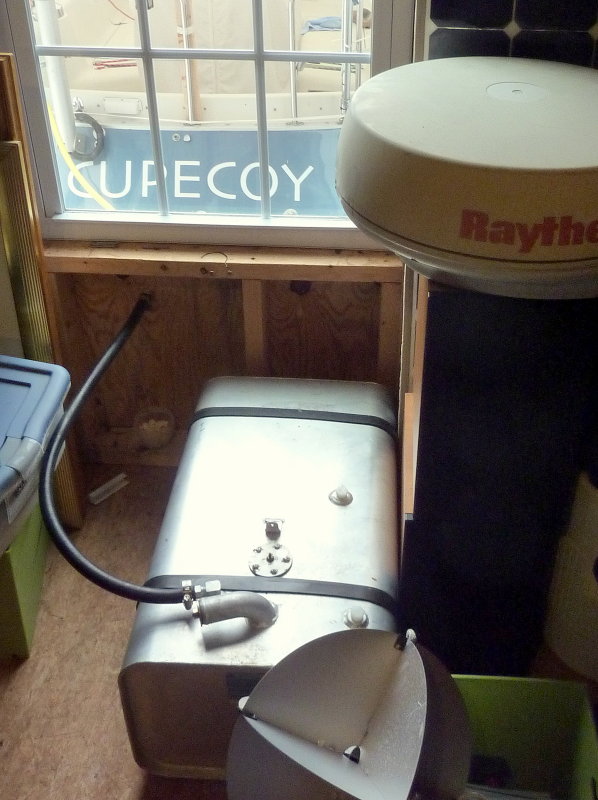
Interestingly enough I have an actual empty Sabre aluminum fuel tank in my barn plumbed up to the exterior with a typical 5/8" vent. The barn has TREMENDOUS temp swings in the winter, especially when I turn on my pellet stove and raise the temp from 5F to 70F in just a few hours.

After more than a year, and all seasons, living right on the humid and wide temp swing coast of Maine, the tank is still 100% BONE DRY. This tank is in no different application than it would be on my boat on the hard. As a matter of fact the vent for the test tank is just 6' from the one on our boat....

I test it every now and then and drop some colored paper in there to see if I can wipe any condensation off the walls. As of yet every test has come up bone dry every single time....

My fuel tank is emptied every winter but this year I have an H2Out and left it full for test purposes. As of yet the beads have not even begun to change color....

never understood why people fill a tank to let the fuel go bad, grow stuff, absorb moisture to its max limit and sit there doing nothing. Every year, until this year, I have 100% drained my tank. It has been bone dry every single year and I start with fresh fuel in the spring, not last years fuel........;)

This year is the one exception, only to test the H2Out, and next year I will go back to draining it..
 
Mar 26, 2011
3,964
Corsair F-24 MK I Deale, MD
Mainsail:

a. You keep your tank empty. A good practice, but not very common. Also less practical where winter is short. And I'm not surprised at the long-life on the gel. We are seeing 2-4 years as common, since there is some regeneration during the exhale phase.

b. An empty tank is irrelevant for comparison purposes in part because the metal also follows the air temperature more closely than a filled tank. Also, no oil present t form a water trap. Thus, it is a false analogy. A better test would be two 50% tanks, one vented and one sealed. I have done that several times. Results are very weather dependent; it seems to be a spring or fall effect, at least around the Chesapeake. Other climates could give VERY different results, explaining differences in expereince. We could all be right.

c. Regarding old fuel, I agree. I alway laugh when someone complains that their 3-year old fuel is bad. They change the oil every year, but not the fuel. Gotta burn it or something.

Don:

You're being stuborn. Are you an API inspector? If so, you would know that there is a rule requiring the inspection of internal roof rafters before entry, because they are very prone to corrode due to condensation and fall on inspectors. I've found more than a few I-beams on tank floors, eaten away by something, on tanks that did not contain sour materials. I'm also guessing that tanks inspectors know far more about reality than a government study, a few I have defeated during regulatory review. Please send me a copy. I bet I can find things I can agree with and I can find reasons their conclusions do not match our global expereince.

Just sayin', I've been in over 1000 tanks and I know what I see and what the code says.

----

I'm not saying the amount of water is large--only 50ppm or so--but is is enough to cause a separate emulsified phase and corrosion. I did not photoshop the photographs, I presented repeatable fact.
 

Gunni

.
Mar 16, 2010
5,937
Beneteau 411 Oceanis Annapolis
There are many, many, many emergency generator fuel tanks around the world filled with diesel fuel that has been in those tanks for a decade (or more). And yet the generators start up each week and run.
 
May 17, 2004
6,154
Beneteau Oceanis 37 Havre de Grace
The barn has TREMENDOUS temp swings in the winter, especially when I turn on my pellet stove and raise the temp from 5F to 70F in just a few hours.
I disagree that heating the area with a stove is a fair analogy to a tank exposed to changing weather. While the stove will warm the area, it does nothing to change the dew point the way that changing weather patterns do. When you warm your barn from 5 to 70, the amount of moisture contained in that air hasn't changed, so it's no surprise that there's nothing to condense when the temperature goes back to 5. In the real world, though, when a warm humid air mass moves in and the dew point goes up to 60, that moisture's going to go somewhere when the temperature drops again. Between that and the lack of fuel to form a water lock as described, I don't think what you describe is really a fair test. Not saying the results are wrong or that they'd be any different in the real world, but someone should definitely try it with a few half full tanks and a few full control tanks to see scientifically what happens.

I think we all can agree that the best thing to do is burn through the tank frequently, but especially on smaller boats that aren't motored far, it's tough just to get through 5 gallons of a 15 gallon tank in a year.
 
May 10, 2008
392
Catalina 355 Boston
Interestingly enough I have an actual empty Sabre aluminum fuel tank in my barn plumbed up to the exterior with a typical 5/8" vent. The barn has TREMENDOUS temp swings in the winter, especially when I turn on my pellet stove and raise the temp from 5F to 70F in just a few hours. After more than a year, and all seasons, living right on the humid and wide temp swing coast of Maine, the tank is still 100% BONE DRY. This tank is in no different application than it would be on my boat on the hard. As a matter of fact the vent for the test tank is just 6' from the one on our boat.... I test it every now and then and drop some colored paper in there to see if I can wipe any condensation off the walls. As of yet every test has come up bone dry every single time.... My fuel tank is emptied every winter but this year I have an H2Out and left it full for test purposes. As of yet the beads have not even begun to change color.... never understood why people fill a tank to let the fuel go bad, grow stuff, absorb moisture to its max limit and sit there doing nothing. Every year, until this year, I have 100% drained my tank. It has been bone dry every single year and I start with fresh fuel in the spring, not last years fuel........;) This year is the one exception, only to test the H2Out, and next year I will go back to draining it..
I apologize if this is a thread drift, but I know both you and Thinwater have been testing the H20ut and since it is not practical for me to drain my tank in the Fall, I leave it full and I would like to use the H2out but I have been concerned about the silica dust falling into the tank if installed vertically. Any thought on how to avoid this other than installing a Racor air separator downstream?
 
Sep 25, 2008
7,691
Alden 50 Sarasota, Florida
Don:

You're being stuborn. Are you an API inspector? If so, you would know that there is a rule requiring the inspection of internal roof rafters before entry, because they are very prone to corrode due to condensation and fall on inspectors. I've found more than a few I-beams on tank floors, eaten away by something, on tanks that did not contain sour materials. I'm also guessing that tanks inspectors know far more about reality than a government study, a few I have defeated during regulatory review. Please send me a copy. I bet I can find things I can agree with and I can find reasons their conclusions do not match our global expereince.

Just sayin', I've been in over 1000 tanks and I know what I see and what the code says.

----

I'm not saying the amount of water is large--only 50ppm or so--but is is enough to cause a separate emulsified phase and corrosion. I did not photoshop the photographs, I presented repeatable fact.
Storage tanks such as you describe all maintain a water bottom, intentionally, making any comparison frivolous. Add in the inevitable leaking roofs and you have your rust issues. Condensation is the least likely cause.

I am not an API inspector. I don't think that even exists. However, I do know what tank farm managers tell me and they are the most knowledgeable folks on the subject.
 
Feb 6, 1998
11,759
Canadian Sailcraft 36T Casco Bay, ME
I apologize if this is a thread drift, but I know both you and Thinwater have been testing the H20ut and since it is not practical for me to drain my tank in the Fall, I leave it full and I would like to use the H2out but I have been concerned about the silica dust falling into the tank if installed vertically. Any thought on how to avoid this other than installing a Racor air separator downstream?
You really want the Racor Lifeguard LG100 with any H2Out install. I would not personally install one without it though they claim diesel won't harm the silica. I have had mine in since last spring and can not denote any change in the color of the beads. From a maintenance perspective they don't seem to need the silica dried out as often as I thought it would. Install is easy but they do need to come up with a mounting bracket.
 
Feb 6, 1998
11,759
Canadian Sailcraft 36T Casco Bay, ME
Mainsail:

a. You keep your tank empty. A good practice, but not very common. Also less practical where winter is short. And I'm not surprised at the long-life on the gel. We are seeing 2-4 years as common, since there is some regeneration during the exhale phase.

b. An empty tank is irrelevant for comparison purposes in part because the metal also follows the air temperature more closely than a filled tank. Also, no oil present t form a water trap. Thus, it is a false analogy. A better test would be two 50% tanks, one vented and one sealed. I have done that several times. Results are very weather dependent; it seems to be a spring or fall effect, at least around the Chesapeake. Other climates could give VERY different results, explaining differences in expereince. We could all be right.

c. Regarding old fuel, I agree. I alway laugh when someone complains that their 3-year old fuel is bad. They change the oil every year, but not the fuel. Gotta burn it or something.

Don:

You're being stuborn. Are you an API inspector? If so, you would know that there is a rule requiring the inspection of internal roof rafters before entry, because they are very prone to corrode due to condensation and fall on inspectors. I've found more than a few I-beams on tank floors, eaten away by something, on tanks that did not contain sour materials. I'm also guessing that tanks inspectors know far more about reality than a government study, a few I have defeated during regulatory review. Please send me a copy. I bet I can find things I can agree with and I can find reasons their conclusions do not match our global expereince.

Just sayin', I've been in over 1000 tanks and I know what I see and what the code says.

----

I'm not saying the amount of water is large--only 50ppm or so--but is is enough to cause a separate emulsified phase and corrosion. I did not photoshop the photographs, I presented repeatable fact.
This the only reason I performed this test is because some netters (SA) suggested that a full tank is always better than an empty one and that an empty tank would just magically fill with water...:D

I knew the outcome before I tested it, had many years of practical experience on my boats, but had to see if there was any truth, even a smidgeon, to the claims...

I have always emptied my tank and burned it in our homes hydronic boiler... Takes me about 15-20 minutes to transfer it with my small pump.....

I plan to start up my polishing system next week and see if any cloudiness is in the fuel. My fuel has never been cloudy and is always bright and clear red. If it has stayed cloud free I may keep it full next winter too as running the day tank for the Espar is kind of a PITA...

Over 1 year and still bone dry....;)


P.S. The test tank vent and my boats vent are less than 7' apart. Her vent is just above the "E"... My barn has wider temp swings though....
 
Feb 6, 1998
11,759
Canadian Sailcraft 36T Casco Bay, ME
I disagree that heating the area with a stove is a fair analogy to a tank exposed to changing weather. While the stove will warm the area, it does nothing to change the dew point the way that changing weather patterns do. When you warm your barn from 5 to 70, the amount of moisture contained in that air hasn't changed, so it's no surprise that there's nothing to condense when the temperature goes back to 5. In the real world, though, when a warm humid air mass moves in and the dew point goes up to 60, that moisture's going to go somewhere when the temperature drops again. Between that and the lack of fuel to form a water lock as described, I don't think what you describe is really a fair test. Not saying the results are wrong or that they'd be any different in the real world, but someone should definitely try it with a few half full tanks and a few full control tanks to see scientifically what happens.

I think we all can agree that the best thing to do is burn through the tank frequently, but especially on smaller boats that aren't motored far, it's tough just to get through 5 gallons of a 15 gallon tank in a year.
Just like on a boat the tank is 100% sealed from the barns atmosphere.

*Return tapping plugged
*Fill tapping plugged
*Supply port plugged
*Fuel Sender installed / sealed

My barn has no effect other than to change the temp of the tank, which many theorize causes it to breathe.... You also may want to visit in the summer when the second floor gets to 120F and 99% humidity....;) This has been a year round experiment, 14 months now, not just winter.


It is vented to the outside, just like a boat... Just like my own boat that sits just 7' from the test tank... If my stove could change the dew point of Maine, well that would be one hell of a stove...:)

Just like on a boat the tank is outside vented.
 
May 10, 2008
392
Catalina 355 Boston
You really want the Racor Lifeguard LG100 with any H2Out install. I would not personally install one without it though they claim diesel won't harm the silica. I have had mine in since last spring and can not denote any change in the color of the beads. From a maintenance perspective they don't seem to need the silica dried out as often as I thought it would. Install is easy but they do need to come up with a mounting bracket.
Thanks Maine,
I was referring to the Lifeguard. I had read in Thinwater's refer in PS that particulate can escape the H2Out canister and that is what I was worried about, however the added bonus would be insuring fuel doesn't contaminate the silica when refueling.
As for mounting--I was thinking this would be a great place to try those Weld Mounts you referred to in another post :)