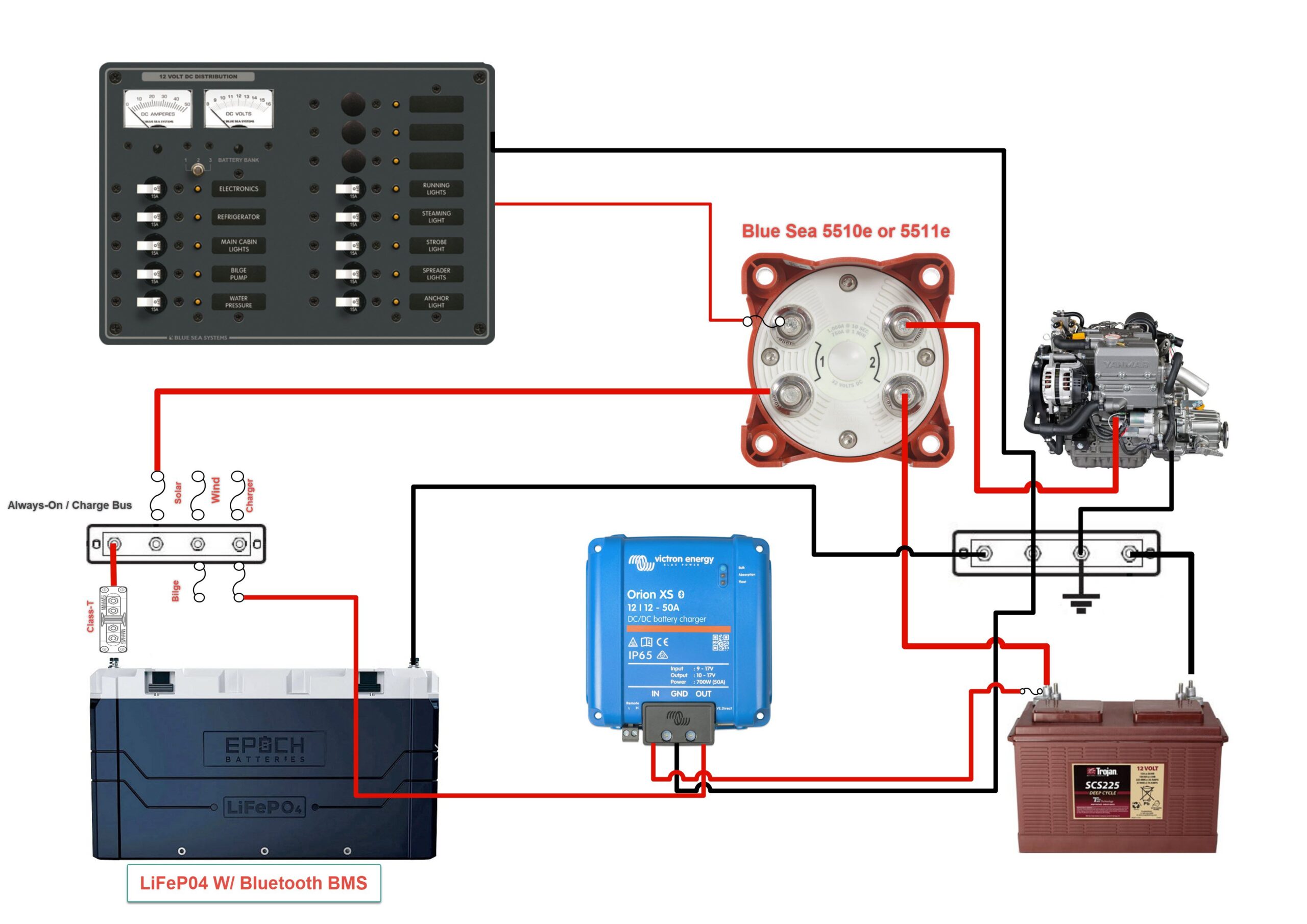
Engine wiring diagram for Hunter 35.5

Jun 4, 2024
40
Hunter Legend 35.5 Charleston SC
Does anyone have a link? Ours is a 95 model if that matters... Do all the Yanmar GM30's use the same harness? I'm looking at converting to lithium, and I am specifically looking in to what is required to separate the alternator from the house bank....
 
Jan 11, 2014
13,488
Sabre 362 113 Fair Haven, NY
Most of the wiring harness will be unaffected by the change in battery chemistry. The alternator output is typically not part of the harness as it should use a larger gauge cable that the wires in the harness. A pretty standard OEM alternator installation has the Alternator output (B+) going to starter motor power lug. From there it goes to the 1-2-All switch to ensure the battery that started the motor gets recharged quickly. Prior owners may have changed this. You will need to do some wire tracing.

Changing to LiFePO4 presents several important concerns, it is not quite as simple as simply dropping in new batteries. How you intend to use your boat will guide you in designing the system. A good place to start is this article from MarineHowTo.com.

 
  • Like
Likes: Rich 35.5
Jun 4, 2024
40
Hunter Legend 35.5 Charleston SC
The alternator output is typically not part of the harness as it should use a larger gauge cable that the wires in the harness. A pretty standard OEM alternator installation has the Alternator output (B+) going to starter motor power lug.

BINGO!!! That is the part I didn't understand, I thought I was looking for a wire from the alt. to the battery switch. That makes this job much less intimidating...
 
Feb 26, 2004
23,152
Catalina 34 224 Maple Bay, BC, Canada
  • Like
Likes: jssailem
Jun 17, 2022
383
Hunter 380 Comox BC
Given the age of your boat, it likely has gone through several owners. Before going down the lithium road, it would be advised to complete an electrical audit and build a diagram of your DC and AC electrical system.

A lithium house bank is usually combined with an AGM or flooded start battery. Given the incompatibility of these two chemistries, each bank must be charged seperately. Additionally, you'll need to ensure you don't over burden your alternator.

Expect to spend $1000-$3000 to update your electrical and charging system before installing a lithium battery. Wire sizes, fuse types and possible separating house load distribution from charging source distributions are all important considerations. There is no such thing as drop-in lithium.

As far as the alternator, you basically have two choirces:

a) charge the start battery. Use then use one or many DC to DC converters to charge the lithium house bank. This converter should be sized to not be beyond 70% of the max current rating of the alternator

b) charge the house battery. You then use a smaller DC to DC converter to charge the start battery. This will require that your external alternator regulator (do you have one???) be programmed for a lithium battery. You probably need to adjust the alternator field output to limit your alternator at 70% of max output to avoid it overheating.

At a minimum, you will probably need/want a new alternator, an external regulator, an alternator temp sensor, new alternator to battery wiring, etc....

If all this seems a bit overwhelming, you could consult a local marine ABYC certified engineer or book a remote consult with Pacific Yacht Systems (Vancouver BC). https://www.pysystems.ca/electrical-design/


The recent ABYC standards have made this whole proposition a little more complex and expensive, as the standard requires communication between the batteries and the alternator and a method to warn the user before the battery BMS disconnects. Very very few lithium batteries and alternator regulators can do this. Although ABYC is not a requirement, most marine engineers would follow the standards if they are certified.

Once you figured out the DC side of the house, you'll need to consider your AC charging needs. The majority of marine AC chargers don't support different chemistries on each output. This means you'll either need only one AC charger and rely on the DC-DC charger or you'll need two seperate AC charging sources.

Here's a typical install with an inverter, solar panels, alternator and separate AC charger for the starter battery (note that most Victron inverters have a secondary DC charging circuit which can be used to achieve this).

For my H380, I ended up with a system very similar to the attached diagram. I already had a 100A high output alternator and external regulator. My alternator charges the start battery. (this is for redundancy, as my solar system charges the house battery). When the ignition is ON (wired in a relay) AND the alternator outputs power, the two DC-DC converters charge the house lithium bank from the alternator (start batt). The voltage rules in the DC-DC chargers makes it impossible to accidentally discharge the start battery. I created a DC distribution bus bar and a DC charging bus bar, all are fused. I have 2 separate AC charge sources (Xantrex inverter and small AC charger for starter batt). Before batteries, probably cost about $1500 in "stuff" and about 50 hrs of work to rewire everything. We have a 410 Ah lithium bank. I have yet to see it go below 80% at anchor in the summer. Looking forward to see how it does this winter (in BC) with the forced air heater running and very little solar output (200W of panels). Underway, my battery bank is fully charged in under two hours.
 

Attachments

Last edited:
  • Wow
Likes: jssailem

jssailem

SBO Weather and Forecasting Forum Jim & John
Oct 22, 2014
23,815
CAL 35 Cruiser #21 moored EVERETT WA
WOW... @marcham, that is some magical system. Beautiful.
 
Feb 11, 2019
25
Hunter 29.5 Bristol, PA
@marcham - Thanks for the detailed info. My 2014 H50 AC electrical system is mostly OEM, but I'm still trying to make sure I understand the existing DC wiring. Haven't been able to obtain a wiring diagram.

@Rich 35.5 - I'm curious how your upgrade is going.

I'm still working on the system layout for an upgrade to Lithium. I'm going to charge the starter bank from the alternator, house from the solar, inverter/charger (inverter/charger can be set to charge Lithium), and a small DC-DC charger (limited to 70% Alternator) connected to the house bank (if I can figure out how to do it right).

It sure is an involved upgrade.....
 
  • Like
Likes: jssailem
Jun 17, 2022
383
Hunter 380 Comox BC
Given the age of your boat, it likely has gone through several owners. Before going down the lithium road, it would be advised to complete an electrical audit and build a diagram of your DC and AC electrical system.

A lithium house bank is usually combined with an AGM or flooded start battery. Given the incompatibility of these two chemistries, each bank must be charged separately. Additionally, you'll need to ensure you don't over burden your alternator.

Expect to spend $1000-$3000 to update your electrical and charging system before installing a lithium battery. Wire sizes, fuse types and possible separating house load distribution from charging source distributions are all important considerations. There is no such thing as drop-in lithium.

As far as the alternator, you basically have two choices:

a) charge the start battery. Use then use one or many DC to DC converters to charge the lithium house bank. This converter should be sized to not be beyond 70% of the max current rating of the alternator

b) charge the house battery. You then use a smaller DC to DC converter to charge the start battery. This will require that your external alternator regulator (do you have one???) be programmed for a lithium battery. You probably need to adjust the alternator field output to limit your alternator at 70% of max output to avoid it overheating.

At a minimum, you will probably need/want a new alternator, an external regulator, an alternator temp sensor, new alternator to battery wiring, etc....

If all this seems a bit overwhelming, you could consult a local marine ABYC certified engineer or book a remote consult with Pacific Yacht Systems (Vancouver BC). Electrical Consultation & Design | Pacific Yacht Systems


The recent ABYC standards have made this whole proposition a little more complex and expensive, as the standard requires communication between the batteries and the alternator and a method to warn the user before the battery BMS disconnects. Very very few lithium batteries and alternator regulators can do this. Although ABYC is not a requirement, most marine engineers would follow the standards if they are certified.

Once you figured out the DC side of the house, you'll need to consider your AC charging needs. The majority of marine AC chargers don't support different chemistries on each output. This means you'll either need only one AC charger and rely on the DC-DC charger or you'll need two seperate AC charging sources.

Here's a typical install with an inverter, solar panels, alternator and separate AC charger for the starter battery (note that most Victron inverters have a secondary DC charging circuit which can be used to achieve this).

For my H380, I ended up with a system very similar to the attached diagram. I already had a 100A high output alternator and external regulator. My alternator charges the start battery. (this is for redundancy, as my solar system charges the house battery). When the ignition is ON (wired in a relay) AND the alternator outputs power, the two DC-DC converters charge the house lithium bank from the alternator (start batt). The voltage rules in the DC-DC chargers makes it impossible to accidentally discharge the start battery. I created a DC distribution bus bar and a DC charging bus bar, all are fused. I have 2 separate AC charge sources (Xantrex inverter and small AC charger for starter batt). Before batteries, probably cost about $1500 in "stuff" and about 50 hrs of work to rewire everything. We have a 410 Ah lithium bank. I have yet to see it go below 80% at anchor in the summer. Looking forward to see how it does this winter (in BC) with the forced air heater running and very little solar output (200W of panels). Underway, my battery bank is fully charged in under two hours.
A little over a year later, now that I'm more comfortable with lithium (lifepo4) and understand it better, I made some substancial changes to improve charge efficiency.

The alternator charges the house battery directly (to about 99%). I then use one dc-dc charger to charge the start battery from the house battery while under way.

House batt (630Ah Lifepo4) charging sources:
- 100 A alternator (outputs 75-80 A once at 75 deg C)
- Inverter/charger
- 3x MPPT chargers with 600 W solar

Start battery (AGM) charging sources:
- 120V shore power charger
- DC-DC charger from house battery

Note that if you have a Victron inverter/charger, it has a small 4A charging circuit for a secondary battery, but the voltages output are the same as those for the inverter's main battery.
 
  • Like
Likes: JR19454
Jan 7, 2011
5,874
Oday 322 East Chicago, IN
I switched my house bank to LFP last year. My starter battery remains lead acid. And the alternator feeds to the starter battery. I added a new battery cut-off switch for the starter battery since I took it off of the 1-2-both-off switch.

i also added a new battery charger for the LFP house bank. A Victron Blue Smart 20 amp charger dedicated to the house bank. Still using the old Guest charger to maintain the starter battery.

I have yet to deal with a dc-to-dc charger to charge the house bank when motoring.

Last year, I used 2) 100 Ah LiFeP94 batteries wired in parallel. They were sold by HumsiENK. Like many people, I had issues keeping the batteries balanced with each other. They were never far apart, but I kept an eye on them religiously, removed them a few times to charge them independently before putting them in parallel again, etc.

At the end of the season, I took them home and ran capacity tests on them….and I got way less than 100 Ah…more like 87 and 89 ah. I contacted HumsiENK, expecting them to offer some sort of partial refund. Instead, they offered to take them back and refund my purchase price (and paid to send them back). I was very happy with that.

That left me thinking about what do to for 2026… and WattCycle offered me a 314ah BT Mini to evaluate. I was happy to test their battery on Tally Ho. Around Thanksgiving, they sent me the 314 Ah BT Mini, a battery charger (60 amp) and a battery monitor to evaluate! Like an early Christmas present:cool:

I ran a capacity test on the battery after charging it up fully. My capacity tester can only pull 14 amps. I set it up to draw 10 amps…and it took over 30 hours to deplete the battery. It recorded 318 Ah’s during the test … a solid result. It also took less space in my battery compartment than the 2) 100Ah batteries I used last year. So that is good.

Since this is a single battery, I am wont have any issues with paralleling multiple batteries…a huge plus after the issues last year. If you can get away capacity-wise with something like this, I think it is a winner.

WattCycle has come out with a “Parallel” function on their App, but I am not sure what exactly it does….and what happens if the phone or whatever is running the app is not present. I have hinted that if want to provide a second 314 Ah BT Mini, I will be happy to evaluate the system.

I made several videos that may help…

The HumsiENK batteries, new Victron Charger, etc.;)


The WattCycle 314Ah BT Mini
The WattCycle 314 Ah Bluetooth Mini is a beast!

WattCycle 314 Ah Mini Battery Install on Tally Ho


Greg