Electrical cleanup

Jul 7, 2004
8,534
Hunter 30T Cheney, KS
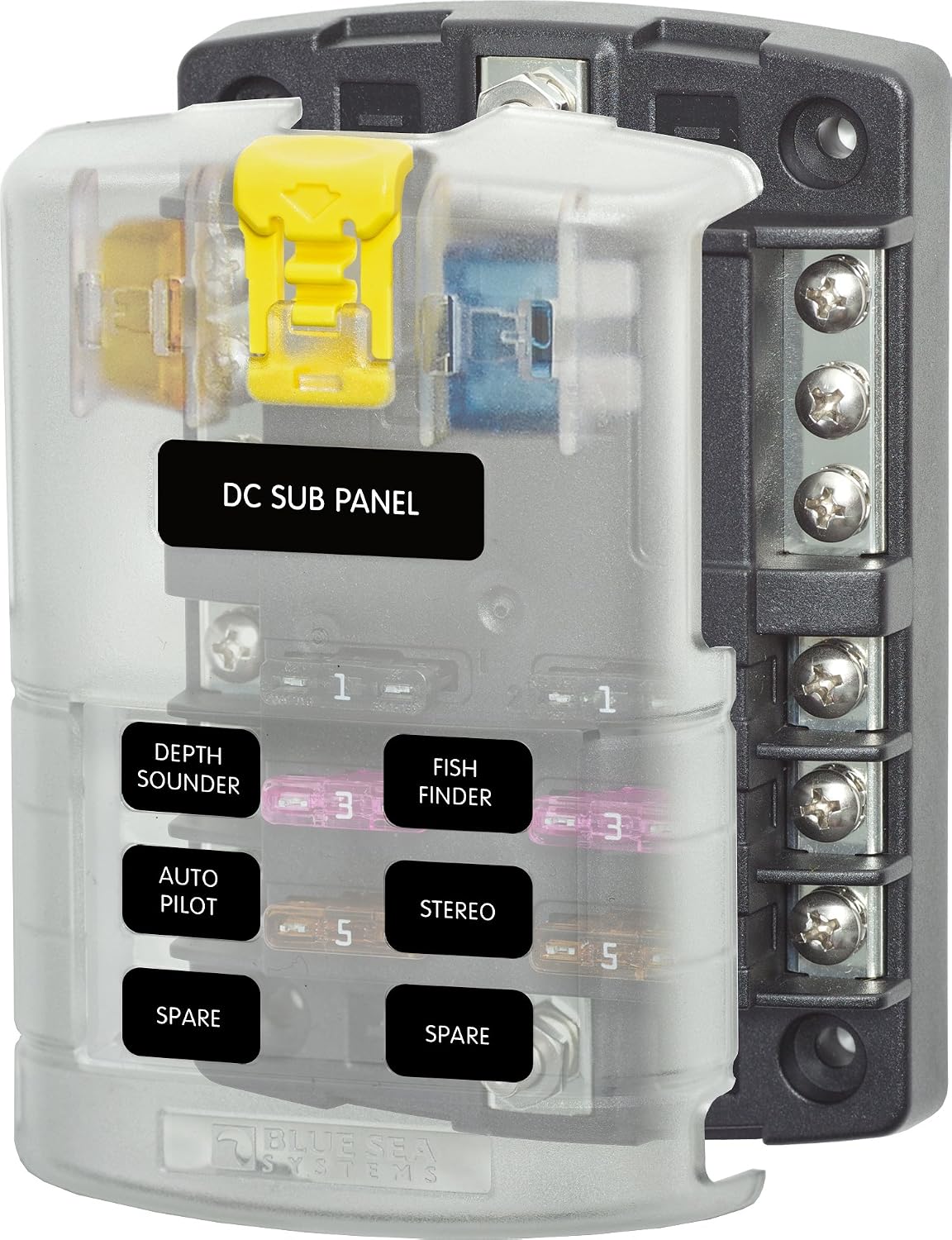
I've begun my holding tank monitor installation and into the wiring layout design. Probe and panel share the same power and ground. So while visualizing the to-be lazerette layout, I see that a PO wired an unfused 12v receptacle and hour meter directly to one of the batteries. I'm thinking rather than route power and ground all the way from the cabin control panel, install this surface mount branch panel in the laz and power the receptacle, meter and monitor from it. Should I supply power from the cabin control panel or from the battery?


Jan 18, 2016
782
Catalina 387 Dana Point
You need to have a fuse between your source and the sub-panel. So from the cabin control panel (assuming fuses or breakers there) - that protects the feed to the small aux panel. Size that fuse/breaker on the wire size fed to the other panel.
 
Oct 24, 2010
2,405
Hunter 30 Everett, WA
It sounds like you're lucky. On my previous boat, I had to replace all of the DC power wiring and AC power wiring in the entire boat due to poor workmanship and poor materials. When I pulled the wiring out there were no DC power wires longer than 18 inches that did not have multiple splices in them. And it was all un-tinned copper wire. The Wire splices we're simply stripped wires and twisted together. Some of them had tape on them. What a mess.

Ken
 
Jul 7, 2004
8,534
Hunter 30T Cheney, KS
You need to have a fuse between your source and the sub-panel. So from the cabin control panel (assuming fuses or breakers there) - that protects the feed to the small aux panel. Size that fuse/breaker on the wire size fed to the other panel.
I agree. Whether I tap into the main panel or from the battery, the supply needs to be fused.
 
Jul 7, 2004
8,534
Hunter 30T Cheney, KS
It sounds like you're lucky. On my previous boat, I had to replace all of the DC power wiring and AC power wiring in the entire boat due to poor workmanship and poor materials. When I pulled the wiring out there were no DC power wires longer than 18 inches that did not have multiple splices in them. And it was all un-tinned copper wire. The Wire splices we're simply stripped wires and twisted together. Some of them had tape on them. What a mess.

Ken
Yeah, I don't think previous owners did much shade tree work on her. All in all she looks pretty good.
 
Feb 6, 1998
11,759
Canadian Sailcraft 36T Casco Bay, ME
I agree. Whether I tap into the main panel or from the battery, the supply needs to be fused.
Unless this is powering a device that must be a direct "always on" battery connection everything should ideally pass through the DC panel and the battery switch. A DC sub fuse panel should be appropriately named on the DC panel such as "DC Cockpit Feed" or "DC Sub Panel". Only the positive feed wire needs to run all the way back to the DC panel and the negative can be taken off the negative distribution bus close to the battery. Do not be tempted to connect the fuse panel to the engine for a negative return path as this can induce unwanted transients...

12V Outlets:

I am not a believer that a 12V outlet on a boat should be fused at any more than about 5A. Beyond 5A +/- these can develop some serious heat which can lead to a fire.

As the springs in the male plug weaken over time, in the 12V+ tip and ground wings, the plug can develop a sloppy fit and work loose. When it becomes loose in the socket we create a point of high resistance which can begin to heat the plug and outlet to the point of fire. This can even occur all at well below a fuses trip point. I have seen this happen with a 15A rated fuse and the fuse never tripped because the owner was not exceeding 15A but the outlet was scorching hot and melting due to high resistance. By lowering the fuse rating to about 5A this a high resistance induced fire is much less likely to occur.

If you follow a few simple rules for 12V DC sockets they can be used in a safe manner.

#1 ALWAYS USE OVER CURRENT PROTECTION
#2 Max fuse size 7.5A (preferably not more than 5A)
#3 DO NOT plug in pumps, motors or search lights
#4 Choose high quality sockets rated for at least 15A (but don't run them at that)
#5 Contact points need to be kept clean (A Dremel works, 12V Power off first)
#6 DO NOT plug in small 12V to 120V inverters. 12V outlet powered inverters are an incredibly dumb idea and incredibly dangerous!
#8 If the male plug becomes loose fitting stop using it and replace it.
#9 Use only for cell phone, camera, tablet or laptop charging with 12V loads less than 5A - 7A

If you follow these simple guidance rules you will likely never have a 12V outlet issue again. High resistance can start fires well below the fuse trip point!
 
Jul 7, 2004
8,534
Hunter 30T Cheney, KS
Thanks MS. I was undecided on the panel feed. I need to check, but I don't think the tank sensor needs continuous power. Maybe it does so the calibration holds? Otherwise I'll come off of the main panel with a new c/b. I have enough red tinned 10ga to reach the laz.
 
Dec 28, 2010
462
Catalina 380 san pedro
I only allow my 12VDC outlets to be used for cell phone charging etc. It's just an unbreakable rule on the boat. I totally agree with MS on this one.
 
Jul 7, 2004
8,534
Hunter 30T Cheney, KS
I ordered the new subpanel. Holy crap, the cost of my project wiring is adding up! I'm doing the mast lights as well.
Taking MS's advice on electrically putting the sub behind the main DC switch. I decided to go with a 6ga supply for it. I need to drill the main panel to add a new breaker to protect this wire to the sub. SBO has some with the same physical size and attachment pattern but 50A is the highest they offer. 6ga is rated for closer to 100A. Not that I need that much, I don't want to limit myself. I'm just running about 15' max. Any sources for a higher rated breaker that will fit?
 
Feb 6, 1998
11,759
Canadian Sailcraft 36T Casco Bay, ME
I ordered the new subpanel. Holy crap, the cost of my project wiring is adding up! I'm doing the mast lights as well.
Taking MS's advice on electrically putting the sub behind the main DC switch. I decided to go with a 6ga supply for it. I need to drill the main panel to add a new breaker to protect this wire to the sub. SBO has some with the same physical size and attachment pattern but 50A is the highest they offer. 6ga is rated for closer to 100A. Not that I need that much, I don't want to limit myself. I'm just running about 15' max. Any sources for a higher rated breaker that will fit?
100A would be just about the max ampacity for the maximum over current protection (OCP) sizing for the wire. This would also be for 105C wire..

In certain cases you can go to 150% of that, but level of OCP if that is necessary, it is always best to go up in wire size and stay at 100% of ABYC max ampacity.

That said you likely do not need OCP at 100% of 6GA wire.

We size wire first for minimum voltage drop (should be sized for 3%) then we address OCP. The max panel load should not exceed 80% of a fuses rating but preferably in the 50-70% range. Unless your DC sub panel has some serious motor starting loads then a 50A breaker should be plenty.

What is going to be on this sub panel?

What is currently feeding your main DC panel in terms of wire gauge?

What is the fuse/OCP that protects the main DC panel feeder?

What is the DC Main breaker on the panel sized at?
 
Jul 7, 2004
8,534
Hunter 30T Cheney, KS
All good questions MS :)
I'll have to check all the c/b ratings, fuses and wire gauges this weekend. I wish I had an accurate wiring diagram. I'm creating one as I go. The subpanel won't have anything serious on it unless I do some deep rewiring. So far it will just be the new holding tank probe and display. the 12V receptacle that is currently unfused as well as an hour meter back there. I will probably add some switched stowage compartment lights in the future. I have 3 cockpit bins and 2 on the stepped transom. A bimini light would be nice someday too, since it stays up all season. that's it...for now. No startup loads.