Dumb vs Super Dumb Alternators

Jan 11, 2014
13,426
Sabre 362 113 Fair Haven, NY
Maine,

In another thread you mentioned "dumb" and "super dumb" alternators. (http://forums.sbo.sailboatowners.com/showthread.php?t=173277&#post1226045)

As he proud owner of a Yanmar/Hitachi "super dumb" alternator could you explain this a bit further and suggest a course of remediation. I've just spent a lot of Benjamins on a new charger (ProNautic) and Dekka 6v GCs and lots of wiring upgrades, I don't want it to all go for naught because the alternator is not up to the job. According to the label, the alternator is rated at 80 amps.

As always, thank you for your insights.

Dave
 
Nov 14, 2013
200
Catalina 50 Seattle
FWIW, I have the same dumb alternator and had it converted to external regulation at an auto electric shop for the princely sum of $35. Now it's controlled by my Balmar regulator and I'm actually getting 80 amps out of it for extended periods of time.
 
Sep 15, 2009
6,244
S2 9.2a Fairhope Al
FWIW, I have the same dumb alternator and had it converted to external regulation at an auto electric shop for the princely sum of $35. Now it's controlled by my Balmar regulator and I'm actually getting 80 amps out of it for extended periods of time.
and that is the difference in dumb you get more out of the alt and also get a belt saver mode that is great ...along with the fact that now your alt will charge in the float mode with the balmar external regulator
 
Feb 6, 1998
11,722
Canadian Sailcraft 36T Casco Bay, ME
Maine,

In another thread you mentioned "dumb" and "super dumb" alternators. (http://forums.sbo.sailboatowners.com/showthread.php?t=173277&#post1226045)

As he proud owner of a Yanmar/Hitachi "super dumb" alternator could you explain this a bit further and suggest a course of remediation. I've just spent a lot of Benjamins on a new charger (ProNautic) and Dekka 6v GCs and lots of wiring upgrades, I don't want it to all go for naught because the alternator is not up to the job. According to the label, the alternator is rated at 80 amps.

As always, thank you for your insights.

Dave
Dumb Regulated - A dumb regulated alternator does BULK and ABSORPTION and that is it. There is no in-built protection for over heating and they do "burn up" quite frequently when used to drive large banks. If the voltage regulation point is 14.4V it will bring the bank to 14.4V and simply hold it there. If it is below 14.4V the alternator is in BULK mode putting out all it can. A healthy and long absorption charge is actually good for deeply cycled marine batteries and is the part of charging that reconverts lead sulfate.

Super Dumb Regulated - Basically the same as above but they have an additional in-built self protection feature that reduces alternator regulation voltage based on alternator temperature. These alternators are horrible for deeply cycled batteries because they chronically under charge them and when you lower voltage you also extend charging time. Lowering the regulation voltage has the net outcome of reducing current output thus allowing the alternator to not cook itself. These are cheap automotive alternators using bottom of the barrel cheap regulators and reducing voltage using a temp gradient is the least expensive way to get these alternators through the warranty period. The alternator maker could care less about your batteries.

Certainly with 15+ hour motor runs getting back to full is possible even with a "Super Dumb" alt but this is hours longer than it would take with a dumb or smart regulator..

Smart Regulation - Smart regulators handle the alt differently, in terms of protecting it. The Balmar's, and some other smart regulators, reduce the field (reduce alternator current output) based on alt temp while the Yanmar / Hitachi reduces the regulation voltage based on alternator temp. With smart regulators voltage is not reduced just current output. While this can extend bulk charging time you still get a healthy absorption stage. This type of regulation is much more expensive and thus why cheap automotive type alternators don't use it..

Absorption voltage is critically important & keeping it at its desired set point for the proper duration means faster & healthier overall charging too. These "voltage gradient" alternators rarely if ever reach the proper absorption voltage and attaining & holding these voltages is absolutely critical for battery health.


The reason the Hitachi charges soooo slow, and you see reductions in current so much, is because the dumb regulator in them is actually dumber than dumb, at least from a "battery charging" perspective......

If you want to protect an alternator, to make it through the warranty period, reducing regulation voltage can work okay. If you actually need to charge batteries, used in deep cycling applications, and do so in a healthy manner the Hitachi's with internal regulation are really quite pathetic. The regulator in them is only about one thing, protecting the alternator from melt downs. It is not about charging performance nor does it care about your batteries. Slap it in a car, where batts are always full, and you're good to go. Put it in a boat with deeply cycled banks and they really perform horribly.


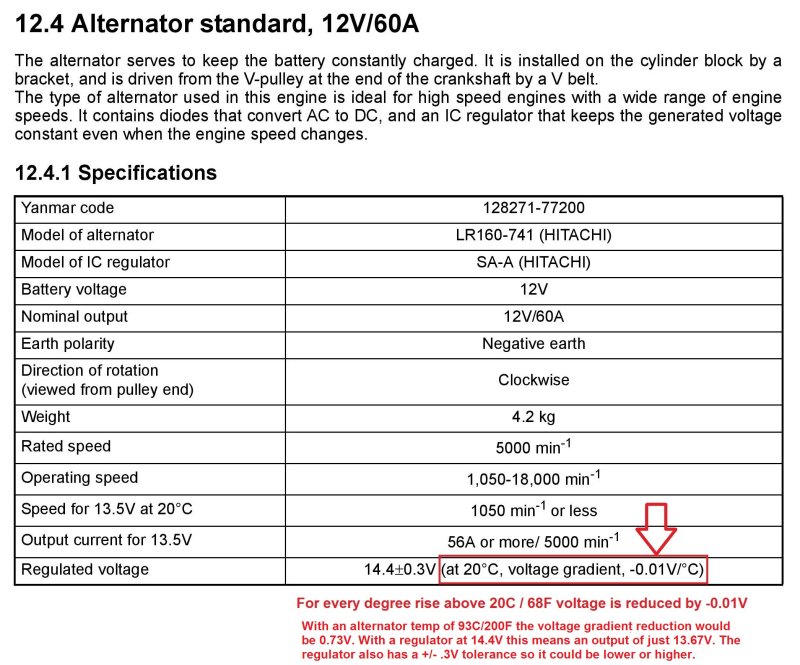
Below is a typical spec sheet for a Yanmar/Hitachi alt:


Note that the regulation voltage is +/- 0.3V which is pretty pathetic but this is what you get from a $1.25 regulator.;) If the design voltage is for 14.4V then you could possibly get one at 14.1V or one at 14.7V. Kind of a luck of the draw kind of specification...:doh: You then subtract the voltage gradient of 0.01V for every degree rise in Celsius above 20C, which is 68F...


You can convert a Hitachi to external but I would strongly suggest setting the Balmar on Belt Manager level 4 and setting the alt temp sensor to temp compensate and reduce field at about 220 degrees if belt manager (formerly called "amp manager") does not cut it. I have seen dozens of burned up Hitachi's that had been converted to external then not set up correctly for alt protection. For example the 80A Hitachi is really only capable of about 45A, in most engine compartments, so as to not exceed about 220F....
 
Jan 11, 2014
13,426
Sabre 362 113 Fair Haven, NY
Maine,

I thank you, but I'm not sure my wallet does! :cry:

When I purchased the boat last year, it had been converted to 6v GCs at some time set up as 2 separate 12v banks, with an old Promariner charger and an intriguing charging system.

According to the literature I had the charger maintained a constant 13.8 volts. The alternator was feed directly to a diode based isolator that kept the voltage at 13.8 volts and supplied the start battery and the 2 house banks.

This spring's project was converting the batteries to one 4 x6v GC system in series/parallel, a new PronauticP charger, a Blue Seas ACR and a Smart Gauge. Next up would be a smart regulator and when I finally burn up the alternator a new one of them.

At this point my electric demands are modest and the boat spends most of her time at the dock and connected to shore power, so the batteries are always fully charged. The opportunity for the current alternator to do damage is relatively small, the batteries will spend very little time at a low SOC.

Thanks again,

Dave
 
May 28, 2015
280
Catalina 385 Atlantic Highlands, NJ
Do you have any suggestions on how I might find out what a standard factory alternator/regulator install is for a new Yanmar 3J series on a Catalina 385 and any changes I might want to consider to configure my system correctly?
 

capta

.
Jun 4, 2009
5,006
Pearson 530 Admiralty Bay, Bequia SVG
Way back when car batteries and the 6 diode 35 amp Motorola alternators were the standard, I used to put a large rheostat in the exciter line and hand regulate the alternator.
I'd begin with a low charge rate to warm everything then turn up the power and charge the batteries for some time, stepping down the rate if I was running the engine for an extended period, though that was rare. It seemed to work just fine and the cheap car batteries lasted the 5 years I owned the boat.
With these modern deep cycle Trojans and a 105 amp internally regulated Delco alternator, I'd like to do the same again, but I'm not sure it would be a good idea. I have a honking great rheo (about 20 ounces but no info) that should handle the exciter amperage, but would this really bother the internal regulator?
Basically, it is a very unusual day when we run the engine at all, let alone any length of time, so I'd really like to get the most out of the alternator when the engine is on.
Any thoughts?
 
Nov 14, 2013
200
Catalina 50 Seattle
Dumb Regulated - A dumb regulated alternator does BULK and ABSORPTION and that is it. There is no in-built protection for over heating and they do "burn up" quite frequently when used to drive large banks. If the voltage regulation point is 14.4V it will bring the bank to 14.4V and simply hold it there. If it is below 14.4V the alternator is in BULK mode putting out all it can. A healthy and long absorption charge is actually good for deeply cycled marine batteries and is the part of charging that reconverts lead sulfate.

Super Dumb Regulated - Basically the same as above but they have an additional in-built self protection feature that reduces alternator regulation voltage based on alternator temperature. These alternators are horrible for deeply cycled batteries because they chronically under charge them and when you lower voltage you also extend charging time. Lowering the regulation voltage has the net outcome of reducing current output thus allowing the alternator to not cook itself. These are cheap automotive alternators using bottom of the barrel cheap regulators and reducing voltage using a temp gradient is the least expensive way to get these alternators through the warranty period. The alternator maker could care less about your batteries.

Certainly with 15+ hour motor runs getting back to full is possible even with a "Super Dumb" alt but this is hours longer than it would take with a dumb or smart regulator..

Smart Regulation - Smart regulators handle the alt differently, in terms of protecting it. The Balmar's, and some other smart regulators, reduce the field (reduce alternator current output) based on alt temp while the Yanmar / Hitachi reduces the regulation voltage based on alternator temp. With smart regulators voltage is not reduced just current output. While this can extend bulk charging time you still get a healthy absorption stage. This type of regulation is much more expensive and thus why cheap automotive type alternators don't use it..

Absorption voltage is critically important & keeping it at its desired set point for the proper duration means faster & healthier overall charging too. These "voltage gradient" alternators rarely if ever reach the proper absorption voltage and attaining & holding these voltages is absolutely critical for battery health.


The reason the Hitachi charges soooo slow, and you see reductions in current so much, is because the dumb regulator in them is actually dumber than dumb, at least from a "battery charging" perspective......

If you want to protect an alternator, to make it through the warranty period, reducing regulation voltage can work okay. If you actually need to charge batteries, used in deep cycling applications, and do so in a healthy manner the Hitachi's with internal regulation are really quite pathetic. The regulator in them is only about one thing, protecting the alternator from melt downs. It is not about charging performance nor does it care about your batteries. Slap it in a car, where batts are always full, and you're good to go. Put it in a boat with deeply cycled banks and they really perform horribly.


Below is a typical spec sheet for a Yanmar/Hitachi alt:


Note that the regulation voltage is +/- 0.3V which is pretty pathetic but this is what you get from a $1.25 regulator.;) If the design voltage is for 14.4V then you could possibly get one at 14.1V or one at 14.7V. Kind of a luck of the draw kind of specification...:doh: You then subtract the voltage gradient of 0.01V for every degree rise in Celsius above 20C, which is 68F...


You can convert a Hitachi to external but I would strongly suggest setting the Balmar on Belt Manager level 4 and setting the alt temp sensor to temp compensate and reduce field at about 220 degrees if belt manager (formerly called "amp manager") does not cut it. I have seen dozens of burned up Hitachi's that had been converted to external then not set up correctly for alt protection. For example the 80A Hitachi is really only capable of about 45A, in most engine compartments, so as to not exceed about 220F....
Thanks, Maine. I've got my Hitachi on the Alt 2 leg of a Balmar MC612 dual regulator with a Delco 140A primary alt on leg 1 of the regulator. It's set up for temp compensated charging but I'll doublecheck the protection temp.