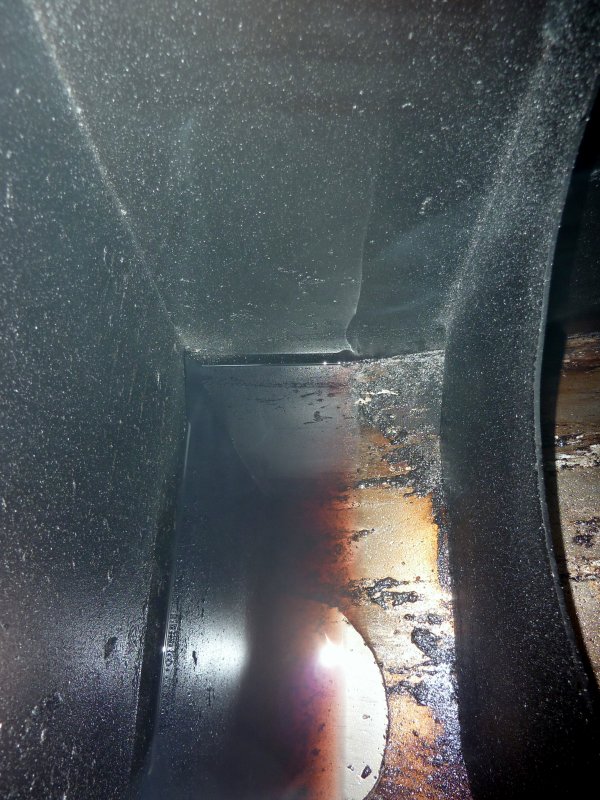
I emptied the fuel tank today and after three years, there was a lot of crap settled on the bottom of the tank. Nothing growing on the sides etc. The tank itself was really clean. I treated all fuel with Stanadyne. I expected some "stuff" but what I found was really surprising. All fuel that I have purchased has been from major fuel suppliers etc. I'm going to start filtering fuel that I take onboard.
Unless the West Coast is vastly different in its fuel filling laws the fuel you get from a fuel pump in the US is already filtered down to about 30 micron but many stations filter to 10 micron. The filters mandated here in Maine are a non-bypass design meaning instead of bypassing when they clog they just reduce flow until the station owner changes them. The marina I fill at uses 10 micron Cim-Tek HSV filters which also shut down the minute water is detected.
I used a Baja and Parker pre-fiter for a few weeks before my marina owner pointed out the level of filtration required by Maine law was far better than what I was doing. I just had to laugh at myself.... The Baja or Parker are only 80+ micron screens and it is no wonder I never caught anything...
This also tells me that I need to open the tank up every few years and clean it out. My new tank will definitely have an access plate upon fabrication. There have been a few threads on fuel tanks and people seem to be reluctant to opening a tank putting an access plate in the tank. DO IT!!!! Before you are forced to do it.......
Even when pre-filtered stuff can
grow in your tanks especially if your deck fill or vent leaks water in there. It may not be coming in at the visible level of filtration but once in there can grow..
I installed an on-board polishing system when I did the tank four years ago. I was just in there in August and the tank looks like brand new, just bare shiny aluminum and bright red, very, very clear fuel..
The entire system cost less than $350.00 but can be done for a lot less. I used a Racor 900 (overkill but I like it) and a Walbro pump. I also installed dedicated supply and return tapping to the tank when I built it..
Our polishing system turns the fuel tank over approx twice per hour and runs when ever the engine does, or when ever we need it to. Since installing the polishing system NO ADDITIVES have been added into the tank, none. The Valvetect fuel I buy is supposed to be treated and they advise not adding anything else.. I had used additives in the old tank and they did less than nothing at keeping the tank clean....
Our boat had used Soltron well before it was marketed in the US as Startron, and it had been in use religiously for the last 15+ years, yet this is what the interior looked like. It should also be noted that this was after TWO treatments Startron Enzyme Formula Diesel Fuel Tank Cleaner. Fuel tank "
cleaner"? Really? Not in my experience... Oh and this tank had also been "
professionally" polished by a dock side fuel polishing outfit. Polished? Really?
I now use only Valvetect fuel and so far in four years with on-board polishing it is working far better than could every be expected.
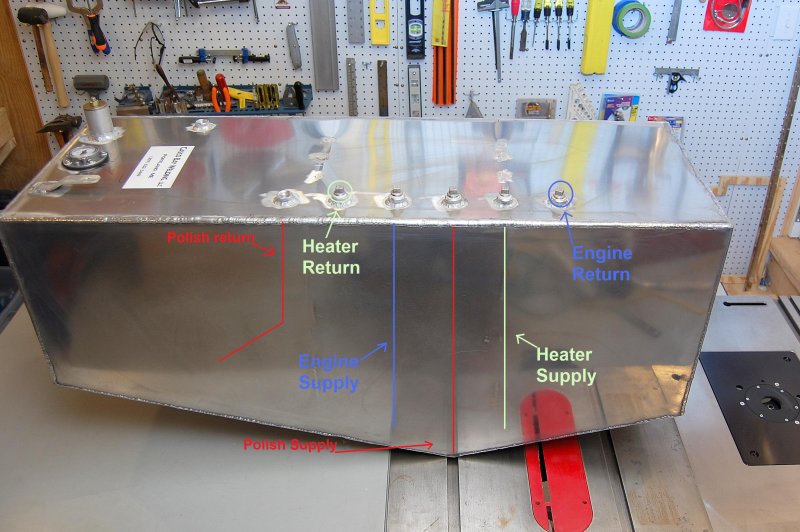
This is our tanks piping layout.
One other thing that may be different, for us, is that I do not believe in filling my fuel tank in the winter. It is drained, not filled....
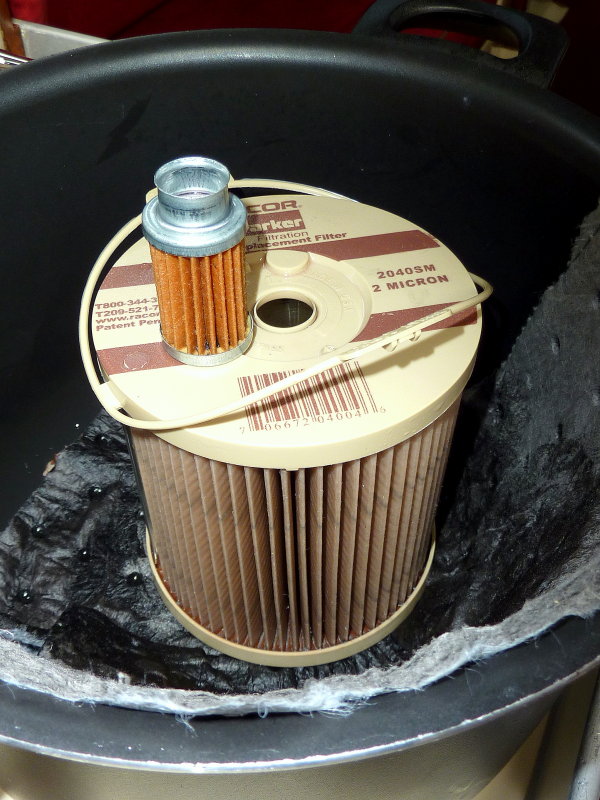
The first season we ran the fuel polishing system for roughly 190 hours and the engine for 111 hours. The second season the polishing system ran for 300 hours and the engine for 122 hours (we have engine driven refrigeration so the engine runs more than most). The third season we ran the polishing for 277 hours and the engine for 127 hours. These are the 2 mic polishing filter and secondary filter for the Westerbeke after 360 total hours of engine running time over a three year period. I inspected them each season then re-installed them just to see how long it would take for them to get "dirty". The primary Racor looks as new..
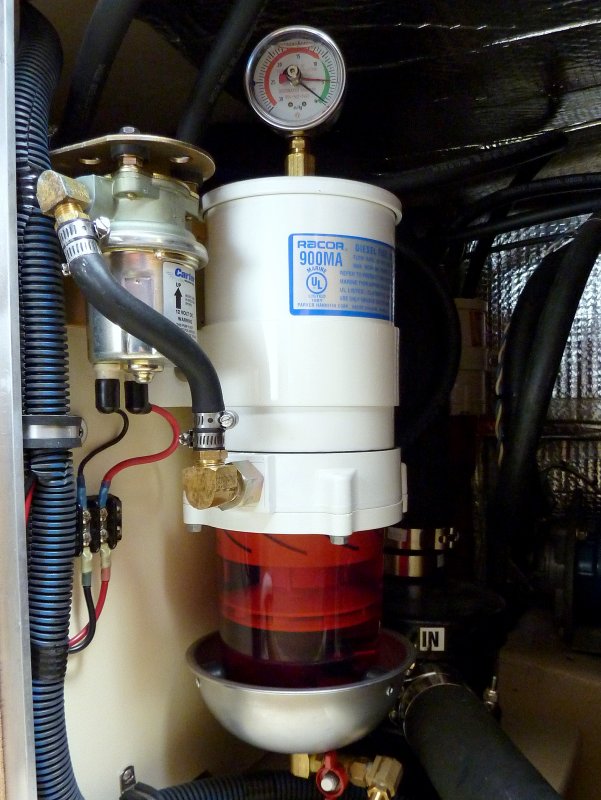
I also use a drag needle vacuum gauge on the polishing system.. This picture shows the original Carter fuel pump that was not designed for continuous duty. I later replaced it with a Walbro specifically engineered for continuous use.
Our system has exceeded my expectations and I know that in the future I will never own another diesel powered boat without a dedicated on-board polishing system...