
sail tackle above cunningham ring
- Thread starter MCENTOM
- Start date

The tackle appears to be attached to the luff of the sail, not the leech. (Leaching is what your septic tank field does.) Have never seen anything like this before. Are the same tackles on the leech too? It looks like there is a similar block and tackle set further up the luff. Perhaps it is supposed to be used to pull the sail down? Would think gravity would do most of that for you. If it is supposed to help with jiffy-reefing the lower end would need to be fastened at the gooseneck and this does not appear to be the case. If Neil Pryde made the sail you may want to ask Neil Pryde what this tackle is supposed to do before you try to optimize it.

I'll hazard a guess, and suggest it was intended as a built in flaking system, not for reefing under sail. Your reef points appear to be the large grommet almost halfway to the first block, then the unused block with the long reinforced strip attaching it to the luff.
-Will
-Will


Oh! This is a good one. Puzzle that is.
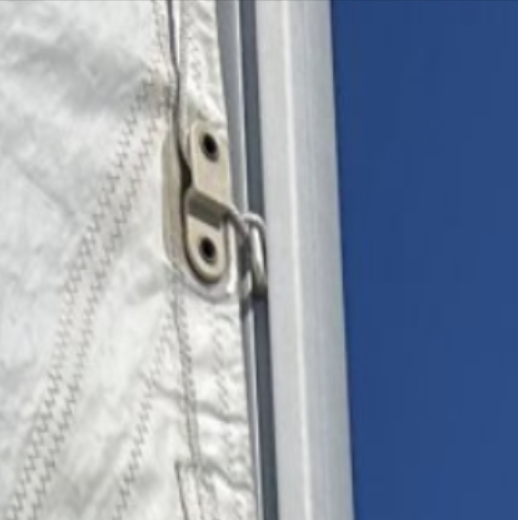
Top one. A line going through the slide and up.
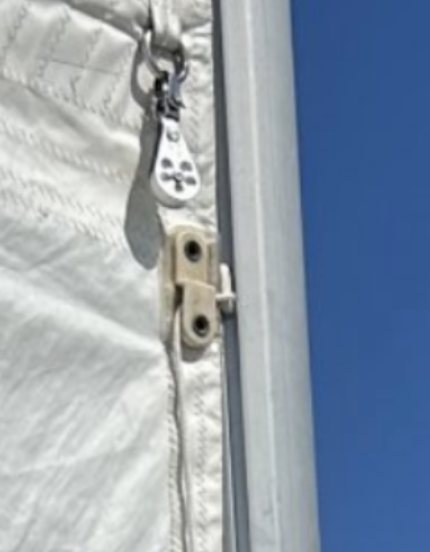
The middle one. A line coming down, going through the slide and down,
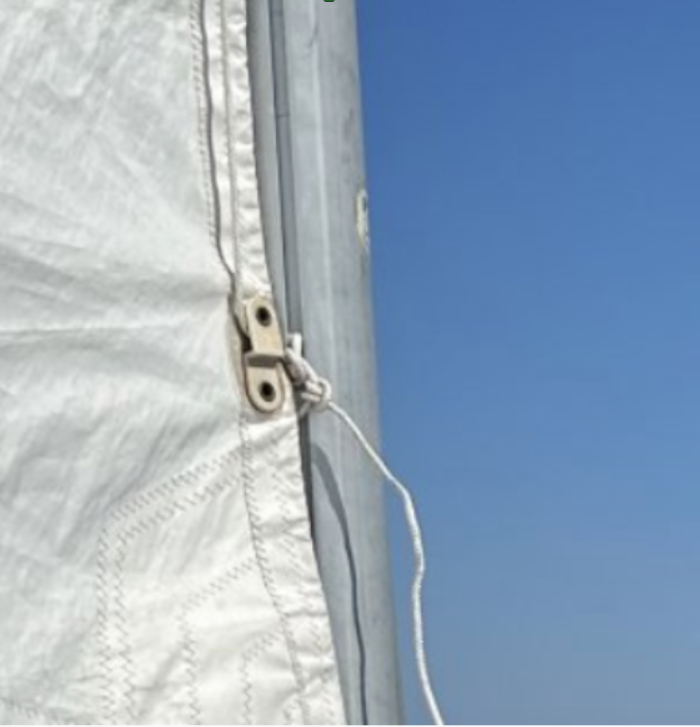
The lower one. A line going down, tied off at the slide and down where it ends.
If you pull on the end of the line, it will pull down the slides.
But "why" on a small light sail?
Why not just have a line from on slide to the next?
What are those white cheek blocks for?
Is it rigged correctly?
I don't know!!
gary
Top one. A line going through the slide and up.
The middle one. A line coming down, going through the slide and down,
The lower one. A line going down, tied off at the slide and down where it ends.
If you pull on the end of the line, it will pull down the slides.
But "why" on a small light sail?
Why not just have a line from on slide to the next?
What are those white cheek blocks for?
Is it rigged correctly?
I don't know!!
gary
Attachments
-
 194.8 KB Views: 38

The thin line connects the sail's luff to the slides. It allows that lower section of sail to pull away from the mast while the sliders stay in place when the mainsail is lowered for reefing. Instead of a bunched up sail, there is easy access for the first reef point to clip into the rams horn, while the "slab" can be pulled away and then rolled up and tucked in snugly on the boom. When hoisting, sliders are already inserted in the slot, the guiding lines pull the sail into alignment with the mast. There's a term for it that I can't remember.
Many sails now come equipped with a strap and ring device for getting the reef point over the bunched sail to the rams horn.
The system was employed to speed up reefing. I think it is pretty effective in that regard.
Many sails now come equipped with a strap and ring device for getting the reef point over the bunched sail to the rams horn.
The system was employed to speed up reefing. I think it is pretty effective in that regard.

Alas, on sailboats, pretty much every line is called a jackline.@Joe is correct. It is called a jackline and lets the lower part of the sail fall away so it doesn't bunch up at the reef point.
Mark
"What should we call this nifty line that gives slack in the main sail luff when reefed, but is tight to the mast when not reefed?
How about a "reef luff tension line" or "reef luff lacing"?
Nah, we'll just call it a jackline like we do everything else. "
Last edited:

I had one, a jackline, on my Mark 25 which was a super up C&C 25. I never understood why it was rigged like that. The boat went out of my life thirty years ago so I have no recollection or way to quantify if reefing was easier or not.The thin line connects the sail's luff to the slides. It allows that lower section of sail to pull away from the mast while the sliders stay in place when the mainsail is lowered for reefing. Instead of a bunched up sail, there is easy access for the first reef point to clip into the rams horn, while the "slab" can be pulled away and then rolled up and tucked in snugly on the boom. When hoisting, sliders are already inserted in the slot, the guiding lines pull the sail into alignment with the mast. There's a term for it that I can't remember.
Many sails now come equipped with a strap and ring device for getting the reef point over the bunched sail to the rams horn.
The system was employed to speed up reefing. I think it is pretty effective in that regard.
It does appear to be a jack line for the sail. Its function is to reduce the sail's stack height and prevent the slugs from falling out of the track.
There should be a sail stop just above the opening for the slugs to enter the mast track. The stop keeps the sail from falling out of the track when reefing or flaking the sail. The line allows the sail to drop lower while the slug remains in the track.
There should be a sail stop just above the opening for the slugs to enter the mast track. The stop keeps the sail from falling out of the track when reefing or flaking the sail. The line allows the sail to drop lower while the slug remains in the track.

I had jacklines rigged on my original JSI sail from Hunter. It turned out that the sail slides would stack up so high I could not get the reefing cringle onto the horn at the gooseneck. I always had to open the sailtrack gate and pull a couple of slides out to lower the stack and engage the sail on the horn. That got old real quick. The solution was a jackline that tied tightly between two sail slides, skipping one or two in between. Normal operation was to not insert those bypassed slides in the track. When fully hoisted the main luff still remained against the mast as tension transferred through the jackline. When reefing, there was plenty of slack in the sail to pull it down to the horns. Later when we bought new sails, our sailmaker (Jocelyn Nash at Quantum) knew exactly where to put the reefing cringles and it was never an issue again.
Thank you for your responses.
Jackline or Luff jackline does yield some additional information. I never thougt about it, but its true that the sail does edge away from the mast when it is lowered. I do not know how the sail might lay if there is a simple plastic shackle to slug connection as there is on the remainder of the sail. As long as the sail is tight to the slug/mast when raised and falls away when lowered or attempted to reef, I guess the line tensioning is satisfactory.
Jackline or Luff jackline does yield some additional information. I never thougt about it, but its true that the sail does edge away from the mast when it is lowered. I do not know how the sail might lay if there is a simple plastic shackle to slug connection as there is on the remainder of the sail. As long as the sail is tight to the slug/mast when raised and falls away when lowered or attempted to reef, I guess the line tensioning is satisfactory.
