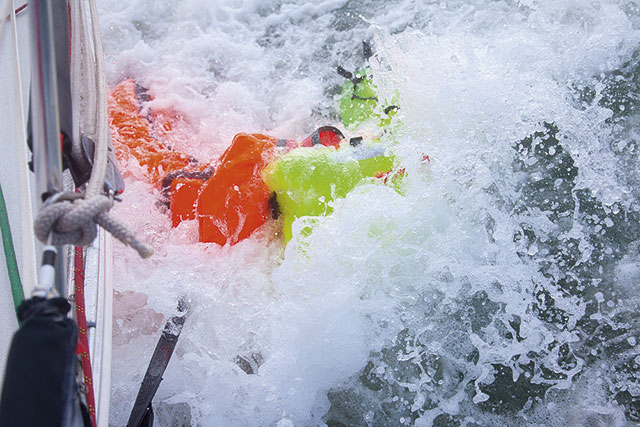
I feel you. I don't use them often, hardly ever on my trimaran. There are only a few tasks where falling off is reasonably possible, and in the unlikely event of capsize (if we're pointing out the paranoid), certainly you are better off without. In the case of working on the bowsprit, tailing a long line (not applicable when single handing; you would have to heave to in order to have any chance of getting back to the boat--often a smart choice) is almost certainly safer. But I have jacklines and think a few points might help newbs weight the issue:I gave up on harnesses and jack lines in the early '80s. All that extra gear, when great footing and easy movement about the decks was necessary, left me feeling I had increased the possibility of my going overboard, exponentially. Also, the thought of going overboard and being bashed to death against the hull didn't appeal to me all that much, when my harness/jack line system kept me up against the hull.
Don't tell me you've figured it out so you can't possibly fall overboard. That just sounds like a very confining and dangerous state on deck. The mentality that something outside your immediate control will save your life has been shown to be the cause of injuries, not a preventative. I've got two hands, and so far, 6+ decades on the water almost continuously, they have been sufficient, except when I needed help from a crew member. They would hold on with one hand and offer me one hand. We then had two hands keeping us aboard, and two doing the job, and two brains, of course.
Going out a bowsprit was the exception. I did that with a line tied around me long enough to reach beyond the stern, tailed by my crew on deck. There, I could be recovered in calmer water. At least that was the idea, but as I never fell off a bowsprit unintentionally, it was just a momentary fit of fantasy.
- Like rock climbing, it is only "all that gear" if you have not worked out your systems or it is not well conceived. You can't just rig them acording to the book and assume they are good. Is there ANYTHING about them that is awkward? Fix it. For example, on a 50' boat you should be able to rig the jacklines so that you cannot fall of from anywhere but the bowsprit (which very few have). They should not be under foot if routed smartly. In my case (last several boats) they are neither anywhere you put your feet nor near the rail. They do not reach clear to the bow or stern. No, they are neither confining nor dangerous, but each boat has its own solutions. As a rule, bow and stern cleats are probably not used; they are just a lazy solution IMO. Install anchors where they need to be. A few local anchors (probably they exist) may be all you need and may be better than jacklines for many tasks.
- Planned movement is the most fundamental practice. You don't need to be scared to death, but you should move securly from hand hold to hand hold and maintain good footing In fact, it is very uncommon for someone to fall off when mindfully moving from point a to point b. It is nearly always when they are working on something at a fixed location. For example, the only time I use them is rigging trolling lines on the outriggers; The motion can be quick, I'm concentrating on what I am doing not the boat, there are no lifelines out there, I'm not holding on, and it is easy to clip off. And BTW, I don't clip to the jacklines, I actually clip to a local hardpoint. I'm not moving.
- Yes, you can get beat to death along side the boat. Driving, your seatbelt can jam and either drown you in a river or trap you in a burning car. Both have happened, and both are silly reasons to swear of seatbelts. The obvious reason is the millions of injuries are prevented or minimized by their use, and we don't hear about the crash where no one was hurt. Same with jacklines; we don't hear about the thousands of sailors that were caught by a tether. They probably didn't even make a mental note of it. We only hear about the very rare failures.
On the other hand, life is risk. I went sailing yesterday, singlehanded in freezing conditions. No PFD. Didn't use jacklines because I barely left the cockpit, other than to raise and lower the main, and there are plentiful holds along that route and the motion of the boat is predictable when dead into the wind. I'm not captain safety and perhaps not the best example. On the other hand, I have a 40-year rock climbing habit, have taken literally 1000 falls on a rope, and so far not a scratch. Careful rigging. I've climbed without a rope. Then I focus on mindful movement, but I can't recommend it. But when is it "climbing without a rope" vs. just easy scrambling? Some of the easy climbing is more comparable to moving on deck without a tether. The key to both is to pay attention.
Another thing to consider is that what is safe for a person who sails often (climbs often) and what is safe for a person that sails less often (occasional climber) is not the same. A beginner or occasional climber should not always follow the lead of the more active and experienced person; they have a polished skill set and situational awareness that goes stale with non-use.